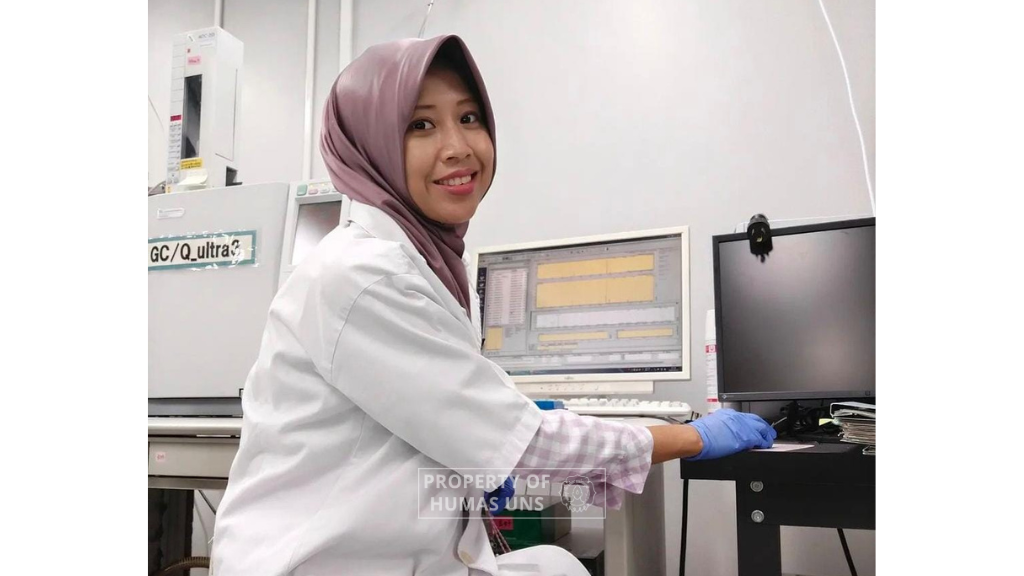
UNS – Mercy Bientri Yunindanova, S.P., M.Si., a lecturer from the Faculty of Agriculture (FP) at Universitas Sebelas Maret (UNS) Surakarta, has successfully identified the unique compounds in Kopyor coconut, a distinctive coconut native to Indonesia. Mercy, a lecturer in the Agrotechnology Study Program, is currently pursuing her doctoral studies at Osaka University, Japan.
Mercy explained that her interest in Kopyor stemmed from its unique characteristics and its exclusive presence in Indonesia. She is driven by the desire to make Kopyor known globally. “In this research, I am guided by Professor Eiichiro Fukusaki, Dr. Sastia Prama Putri, and Prof. Henky Novarianto,” Mercy explained.
Her research is in collaboration with the National Research and Innovation Agency (BRIN) of Indonesia and is funded by research grants from the Indonesia Endowment Fund for Education (LPDP). The Kopyor samples were obtained through cooperation with the government of Pati Regency, Central Java, and local Kopyor farmers in Pati.
“Kopyor is a unique coconut from Indonesia, one of the largest coconut producers in the world. Globally, there are other unique coconuts like Macapuno from the Philippines and Curd Coconut from Thailand,” she added.
Kopyor coconut has a soft endosperm or flesh, unlike regular coconuts. Despite being one of the most popular coconuts worldwide, there is limited research on its properties, including sensory attributes and metabolite profiles.
Mercy studied the characteristics of Kopyor using sensory evaluation, metabolomics approaches, and multivariate analysis. Sensory evaluation involves testing the sensory properties of Kopyor, including taste, flavor, aroma, aftertaste, mouthfeel, texture, and color of both the water and flesh. Metabolomics is the comprehensive identification of metabolites (compounds in biological samples) in plants and fruits using specific instruments such as GC-MS (Gas Chromatography-Mass Spectrometry) and LC-MS (Liquid Chromatography-Mass Spectrometry), along with multivariate analysis.
The research revealed that Kopyor has distinctive characteristics compared to normal young and mature coconuts. The water and flesh of Kopyor have a more complex taste compared to regular young and mature coconuts. This study is the first to analyze the sensory attributes and metabolomics of Kopyor. Metabolomics analysis showed that Kopyor contains a wider variety of metabolites, including higher levels of amino acids, organic acids, and sugars, than normal coconuts of the same age.
“Based on differential and orthogonal regression analysis, Kopyor water is characterized by the accumulation of compounds related to taste, such as amino acids and organic acids, which contribute to its sensory complexity,” Mercy stated.
Mercy’s research highlights the significant potential of Kopyor as a functional food source, supporting the sustainability of Indonesia’s coconut industry. Additionally, her research can serve as a reference for studies on other unique coconuts worldwide. Her findings have been published in the Journal of Bioscience and Bioengineering in 2024, under the title “Characteristics of kopyor coconut (Cocos nucifera L.) using sensory analysis and metabolomics-Based Approach.”
HUMAS UNS
Editor: Dwi Hastuti