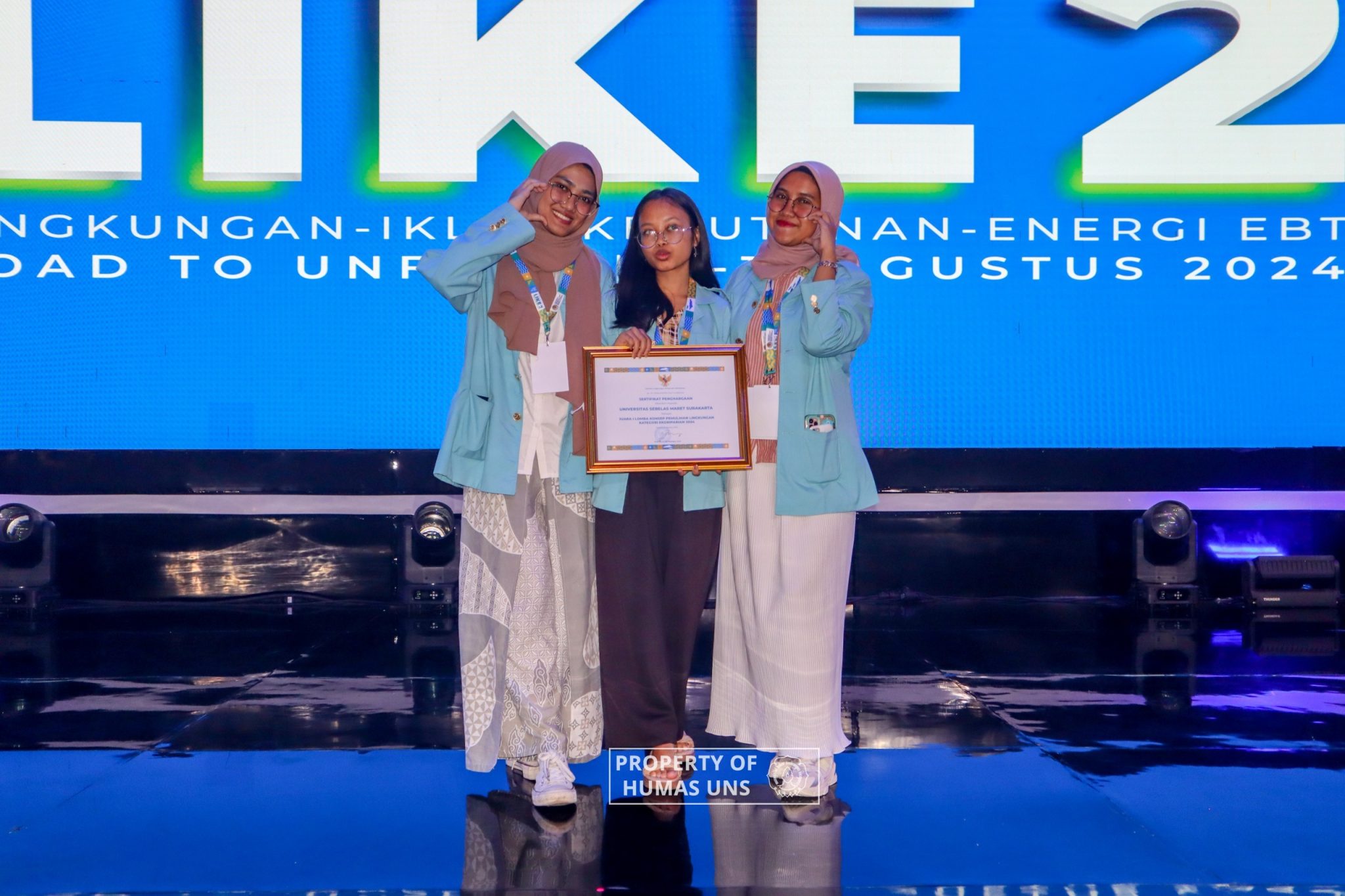
UNS – Two students from the Environmental Science undergraduate program at the Faculty of Mathematics and Natural Sciences (FMIPA), Universitas Sebelas Maret (UNS) Surakarta, Aulia Rahmatya Adiningsih and Angela Regina Astuti, have emerged as winners in the 2024 Ecoriparian Environmental Restoration Concept Competition. They collaborated with Lu’lu Raedah Muchsis, a student from the Faculty of Engineering (FT), to represent UNS in the national competition organized by the Ministry of Environment and Forestry (KLHK) of the Republic of Indonesia.
The announcement of the winners took place during the prestigious LIKE 2 Festival (Environment-Climate-Forestry-Renewable Energy) held by KLHK from August 8-11, 2024. In the top 10 session, the UNS delegation outperformed representatives from Universitas Gadjah Mada (UGM), Institut Teknologi Bandung (ITB), and Universitas Krisnadwipayana. The award ceremony was held at the Jakarta Convention Center (JCC) in Senayan, Central Jakarta, on Saturday (10/8/2024).
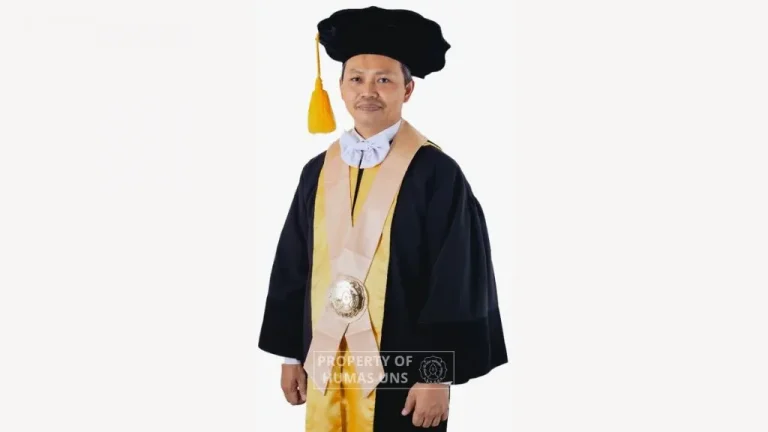
The UNS team was directly mentored by Prof. Dr. Ir. Prabang Setyono, S.Si., M.Si., C.EIA. IPM., a lecturer in the Environmental Science program at FMIPA. The competition aimed to engage and create influential experiences for the younger generation to become actively involved in environmental management efforts. It also sought to identify and build networks of local heroes who could collaborate with KLHK to address the triple planetary crisis. Additionally, the competition aimed to capture innovative ideas from the youth to identify pollution and environmental degradation issues and find sustainable solutions that benefit society.
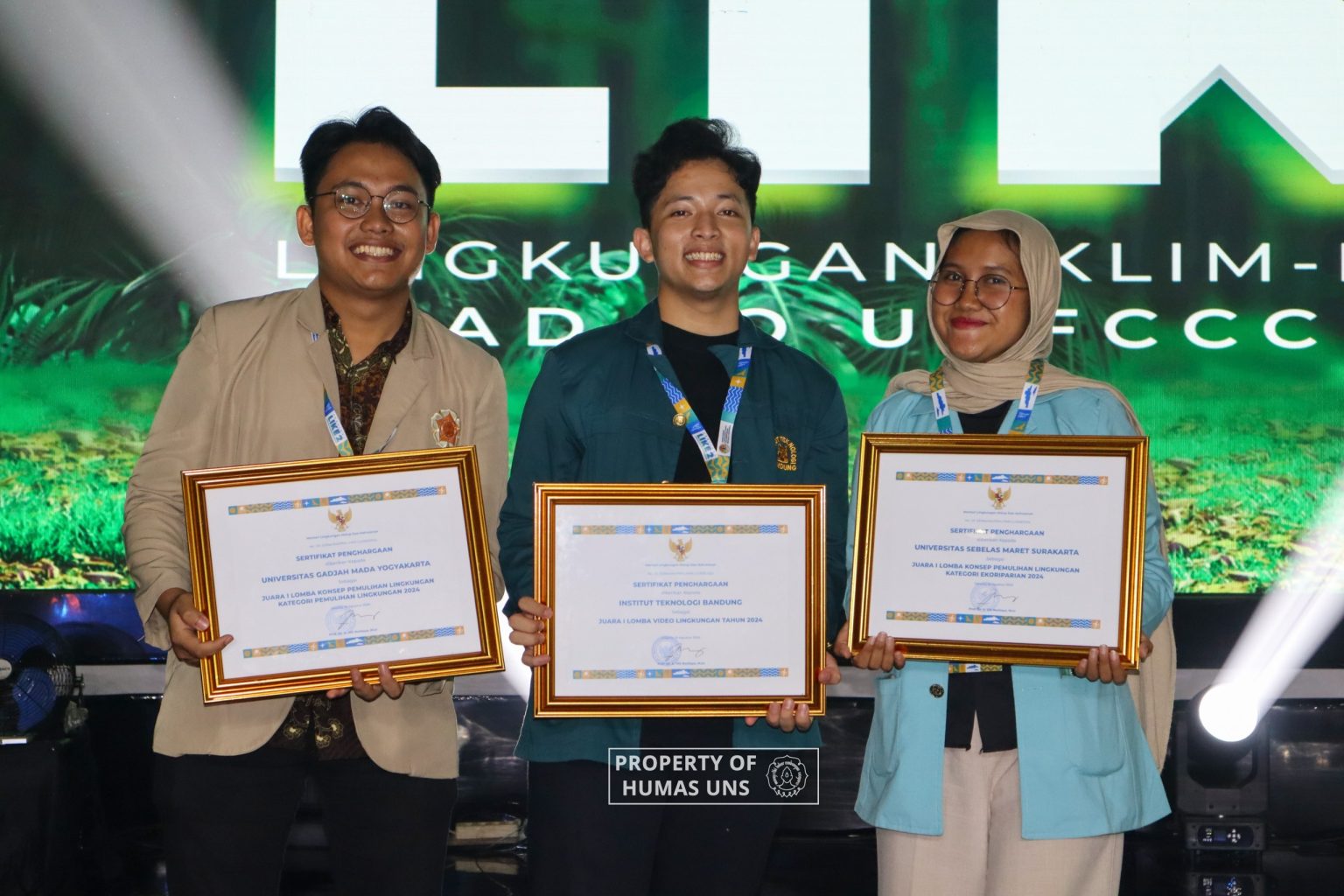
Aulia and Angela, representing UNS, presented an environmental restoration concept focused on the Semanggi area in Surakarta.
“The concept emphasizes the conversion of riverbanks (ecoriparian) into a front porch that serves as a public space for social interaction as well as providing urban green open spaces (RTH),” Aulia explained on Friday (16/8/2024).
The involvement of the community in restoring riparian areas was a key strength of the UNS delegation’s concept. One of the innovations included the use of bioremediation approaches to complement the treatment of domestic wastewater in wastewater treatment plants (IPAL).
Humas UNS
Editor: Dwi Hastuti