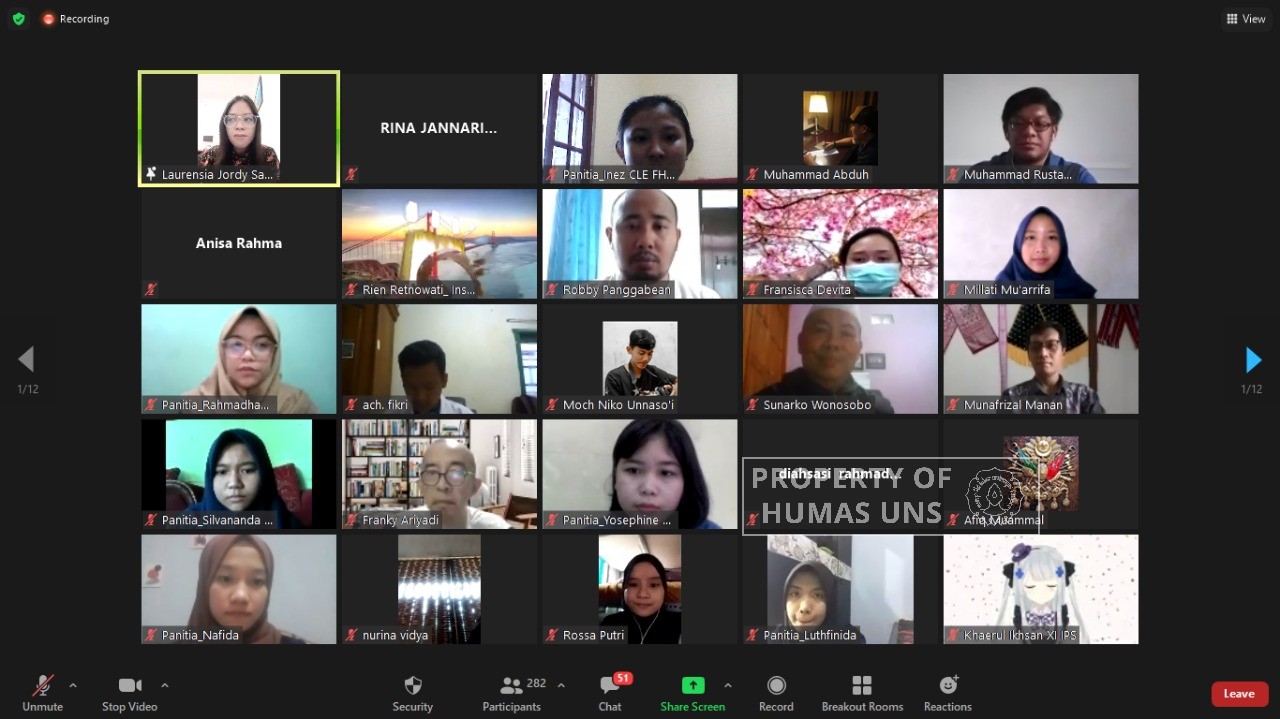
UNS — Clinical Legal Education (CLE) Faculty of Law (FH) Universitas Sebelas Maret (UNS) held a Public Hearing and Discussion (Duplik) webinar on “Social Welfare Funds Corruption Case amid the Pandemic: is Capital Punishment Consistent with Human Rights and/or Constitution”. The event was held through Zoom Cloud Meeting on Saturday (23/1/2021).
The webinar was held to respond to the current debate on the appropriateness of capital punishment for corruptors after the former Minister of Social Affairs in Indonesia Maju Cabinet, Juliari Batubara, is named as a suspect in Covid-19 social welfare funds corruption by KPK. CLE FH UNS invited two keynote speakers to discuss the matter.
The first speaker is Munafrizal Manan, Deputy of Internal Affairs National Committee for Human Rights Protection (Komnas HAM), who discussed “Capital Punishment from Human Rights Perspective”. In his presentation, he first explained that Human Rights is the most fundamental right owned by a person. Article 3 of the Universal Declaration of Human Rights (UDHR) explicitly mentioned that ‘Everyone has the right to life’ emphasized in Human Rights.
“The guarantee of the right to life is strengthened in Article 6 (1) International Covenant Civil and Politic Rights (ICCPR),” Munafrizal Manan explained.
He also stated that the right to life is the crown of Human Rights because it is considered a non-derogable right, an irrevocable right under any circumstances. Therefore, the right to life is a supreme right and irrevocable even in an emergency setting. A country has a positive obligation to protect and guarantee the right to life. In connection to the ongoing debate concerning capital punishment for corruptors, Munafrizal stated that international laws had not issued a binding regulation to ban the application of capital punishment.
Capital punishment implemented in many countries, according to Munafrizal Manan, is reserved for serious law violations such as narcotics and corruption. He also stated that capital punishment could not be charged against children, pregnant women, and people with a mental disorder. However, amid the controversy, he said that capital punishment is not the wisest decision. In some cases, people charged with capital punishment were found innocent afterward. Even if someone is guilty, the appropriate punishment is not capital punishment (fallibility of the criminal justice system).
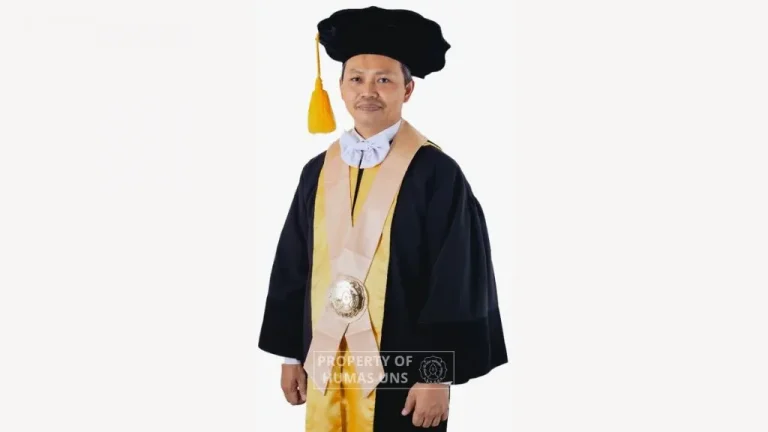
The second speaker, Dr. Muhammad Rustamaji, the Head of Law Science Program FH UNS, discussed the Constitutional Court (MK) verdict regarding capital punishment implementation. Three rulings were made by the Constitutional Court that captured Dr. Muhammad Rustamaji attention. For example, MK Verdict Number 2-3/PUU-V/2007, dated 30 October 2007, has legal consideration from Article 28A and Article 28I paragraph (1) UUD 1945.
The verdict was issued after Edith Yunita Sianturi and friends as plaintiffs filed for Legal Review of Law Number 22 of 1997 regarding Narcotics against UUD (Constitution) 1945. “The first review also has a connection with MK Verdict Number 15/PUU-X/2012 and No. 107/PUU-XIII/2015,” he explained.
He also stated that based on Verdict No. 107/PUU-XIII/2015, MK cancel the application of Article 7 paragraph (2) concerning the Amendment on Clemency regarding the time to file clemency to the president. “This (verdict) means that MK grants freedom to convicts to apply for clemency at any time. This verdict amended the existing regulation in which clemency should be filed no longer than a year after a verdict with permanent legal force,” he concluded. Humas UNS
Reporter: Yefta Christopherus AS
Editor: Dwi Hastuti