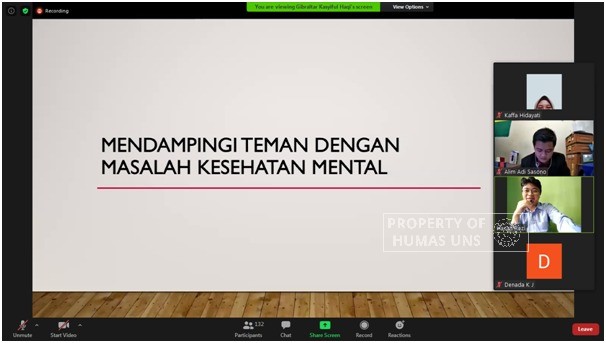
UNS — ‘Here to Hear: Be Empathetic’, a theme of discussion on mental health held by the Student Executive Board (BEM) Faculty of Medical Science (FK) Universitas Sebelas Maret (UNS) Surakarta in the webinar “Health Talk: Psychological First Aid” held on Sunday (13/9/2020). The webinar was attended by around 140 participants from students and school students.
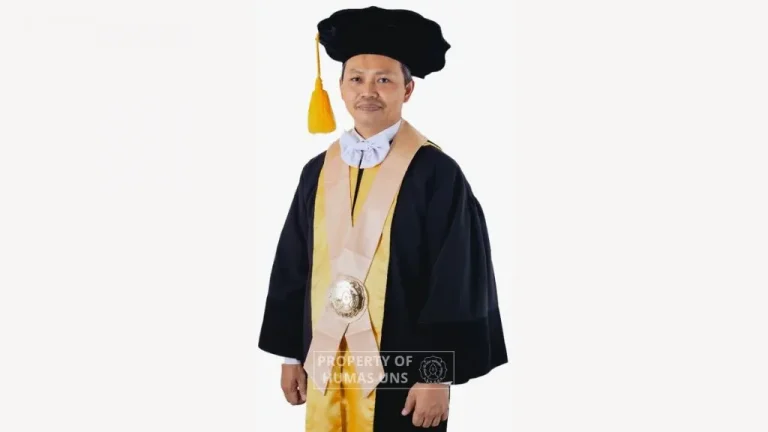
Together with Hasan Fahrur Rozi, S.Psi., M.Psi., Clinical Psychologist who is also an alumnus from Psychology Program UNS, the webinar provides a room for sharing on how to accompany friends with mental problems. How to present oneself besides a friend who went through problems that empathize with them. Hasan underlines the initial attitude that one’s need to pay attention before accompanying their friends who went through a problem: an understanding that everyone has their viewpoint. Somebody can express their view, under certain limitation.
“We need to understand that we have no obligation to solve other’s problem. We only need to accompany them, that, as long as they allow us to. Make a limit between ‘I help’ and ‘I force’,” Hasan, the Head of Himapsi UNS 2015 stated.
Hasan also mentioned that there is two technique of assistance, listening and speaking. In listening, there are three important points, first, need to understand other’s point of view or our friend and understand their needs. Do they want to be heard, or do they need our suggestion? Because sometimes, someone with a problem or under pressure only want to be heard. Then, the listener needs to focus on the content of our friend’s story and avoid focusing on finding a solution or building personal perception. Listening in itself is a solution. A listener needs to train themselves by saying ‘Wait I am listening now’, so that they can empathize, understand other’s point of view, and what they feel.
In speaking technique, Hasan explained that several points demand attention. Avoid judgement or blaming, shows empathy verbally, assure friends that we are there and ready to accompany them to face the current conditions. On the other hands, projecting problem requires caution. Do not provide a solution for personal interest, and one’s should emphasize that what they say is their opinion or point of view by saying ‘in my opinion, from my point of view”. “Never use ‘you must’, it gives an imposing tone. We must emphasize that ‘this is my opinion’. It is okay to have a different view, but let your friend respond to it by asking them ‘what do you think?’” Hasan explained.
However, when they ask for a solution and opinion, we need to understand, respect, and discuss what has been done to solve the problem. If both are at loss, it is important to get professional suggestions. Professional help is necessary when someone shows symptoms of persisting psychological problems, which disturb daily activities, reduce or increase function and role abnormally, and when someone shows the intention of self-harming. Humas UNS
Reporter: Kaffa Hidayati
Editor: Dwi Hastuti