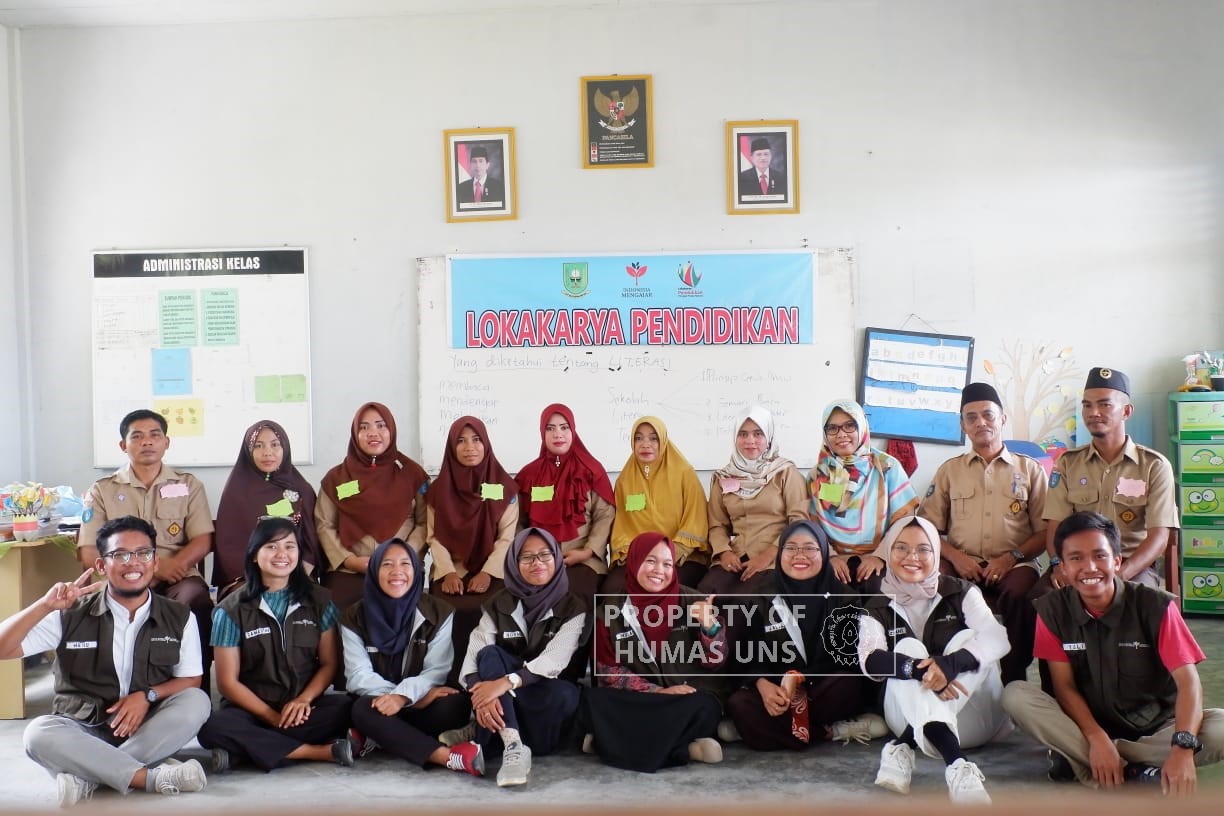
UNS — The interest to view Indonesia from a different angle brings Norma Ayu Setyabudi to a community services program with Teaching Indonesia (Indonesia Mengajar – IM) in Natuna island. For a year from the end of 2018 to the beginning of 2019, the alumnus of Special Education program (PLB) Universitas Sebelas Maret (UNS) tried to contribute to the development of education on the small island.
For Yayak, her short name, ‘another viewpoint,’ can be found by visiting new places and meeting new people. She also has a more personal reason. Through IM that brought her to meet new school children, she wanted to maintain the spirit of childhood in her 25 years old age. “I am the type of person who once falls, will find it hard to get back. It is different from children. When they fell from their bike in the morning, they will get back in the afternoon. Happy again. My main reason, I want to expand my praying and prostrating places,” Yayak stated, Friday (27/11/2020).
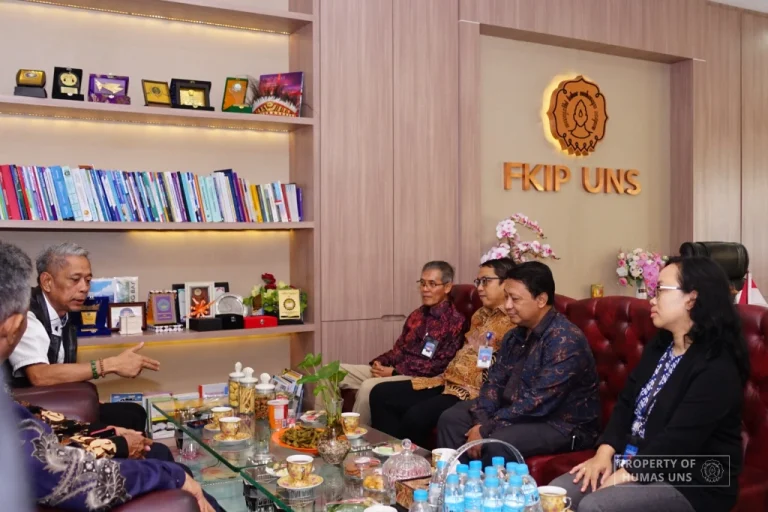
In the discussion, Yayak shared another viewpoint on Indonesia that she found from various exciting experiences and challenges during her stay in Natuna. First, to teach in Natuna needs not only spirit and energy but also the risk of life. The school she taught was located between the sea and a cliff. Once, her school slides and is hit by the waves. The culture of the community also poses another challenge. People in Natuna are really close and depend on nature. This condition affects how education was implemented on the island. She gave an example during the cloves harvest season, children will choose to participate in the harvest instead of going to school. When rain falls in the morning, children will not go to school in the morning and wait until the rain stops.
The same cases also apply to teachers. One of the headmasters often absent from school because he went to the sea. The income from fishing in Natuna during the good season can reach up to IDR 5 – 6 million in three days, higher than a civil servant (PNS). “When people have panggih (a wedding procession), the teachers are invited. The students get a free day. And they always make such occasion to fall in workdays,” Yayak added while laughing.
Considering these cultural challenges, Yayak said that it is not easy to fix the existing education system. This condition also made her aware that there should be special autonomy for each region in managing its education system, especially in the 3T (disadvantaged, frontier, and outermost) regions. The presence of IM, Yayak said, did not instantly change and fixed the existing system. The target of IM is to change community behavior, which cannot be achieved in a one- or two-years period. Further, she added that IM volunteers tried to minimize certain parts that require improvements. They also act as a supporting system. Encourage, invite, and train people in Natuna to continue their work after they leave the island. The real implementation of the efforts is through establishing a relationship with direct stakeholders such as parents, teachers, and the government. Advocacy was also performed because there were village funds allocated for education but is not implemented.
“We initiated two forums, at village level and Sub-District level. The approach we used was we participated in potential people activities. I once went to the sea, get coffee together while chatting. All with the hope that they are open for discussion and to listen to our ideas,” the Yogyakarta girl explained.
The experience and lessons from Natuna incited a new dream for Yayak; to learn urban planning. The unsafe position of the school showed that from urban planning concept, most of schools in Java are safe. But that is not the case for the 3T regions. She realized that solving educational problems requires supports and considerations of diverse factors, including urban planning. Yayak stated that currently, she is enriching her portfolio to pursue a study in urban planning and become a professional in this field. “To support the education from this field,” she explained.
At the end of the discussion, Yayak shared her hope for children and education in Indonesia. She hopes that in the education process amid the digitalization era, ‘children will remain children’. That they should not be forced to do something they do not like or do not need. Parental control and collaboration among multi actors are necessary for this process. Humas UNS
Reporter: Kaffa Hidayati
Editor: Dwi Hastuti