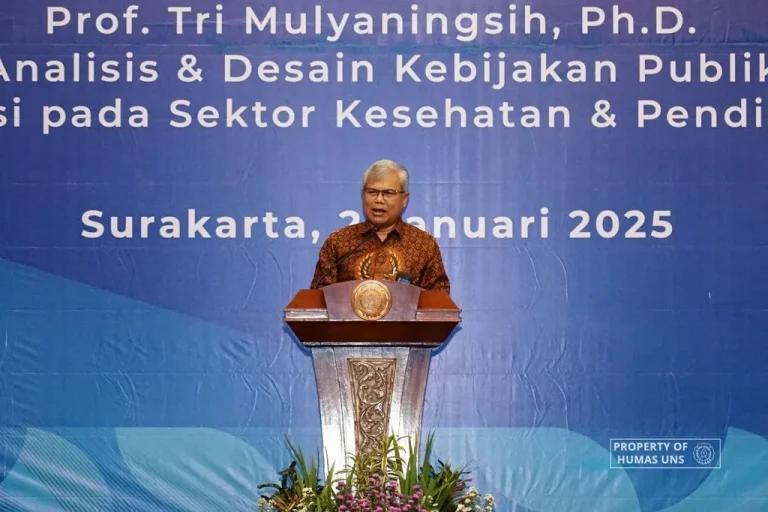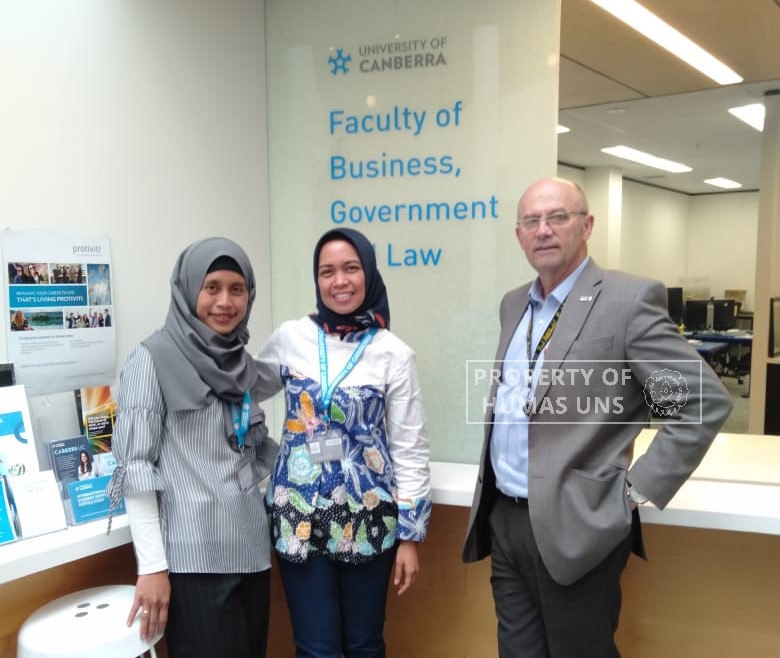
UNS — An international research collaboration on Multilevel Determinants of Childhood Stunting conducted by three researchers of Universitas Sebelas Maret (UNS) Surakarta, Tri Mulyaningsih, SE., M.Si., Ph.D and Dr. Vincent Hadiwiyono from the Faculty of Economics and Business (FEB), and Vitri Widyaningsih dr., MS., Ph.D from the Faculty of Medical Science (FK). The research was funded by LPPM UNS through International Research Collaboration Scheme UNS from 2020 to 2021. The three UNS researchers collaborated with Itismita Mohanty, Tesfaye Gebremedhin, and Riyana Miranti from the University of Canberra.
Through a phone call, Tri Mulyaningsih, Ph.D. described that this research discussed children malnutrition and focused on stunting, which is the most serious children malnutrition problem in Indonesia. This is also inseparable from the effect of stunting on children’s growth and the quality of Indonesia human resources in the future. Children who experienced stunting, Dr. Tri added, have imperfect cognitive and intellectual development. These children also have limited productivity and have a higher risk of contracting an illness. “Especially non-communicable diseases such as diabetes, cholesterol, and coronary disease,” Dr. Tri explained to uns.ac.id, Tuesday (10/11/2020).
In addition to the health, the research also tries to analyze the effectiveness of government’s programs in handling stunting, and how socio-economic policies and conditions affect stunting cases in Indonesia, including the family socio-economic condition. Therefore, the samples of the research were collected from the Indonesian Family Life Survey (IFLS) or household data in the batch 4 (data 2007-2008) and batch 5 (data 2014-2015). In which an observation was held on 8,544 household data that can be classified into batch 4 with 4,309 data and batch 5 with 4,235 data.
Concerning the result of this research, Dr. Tri explained that many levels affect the malnutrition or stunting in children, for example, the child’s condition, household, family socio-economic, and environment (region). On child’s condition, the researchers concluded that children have a high risk of malnutrition and stunting when they were born with low weights, from mother with poor malnutrition, experienced acute diarrhea, and consumed unhealthy snacks. Diarrhea can reduce the eating pattern and reduce body metabolism ability in absorbing nutrition, while unhealthy snacks generally have high fats and calories but have low protein and micronutrition.
Further, Dr. Tri explained that at the household or family level, children who grow and raised in a family with low income have a higher risk of malnutrition which is strongly related to the fulfilment of childhood nutrition. There is also a parent’s education which also affects. Lack of education leads to a lack of knowledge of children nutritional needs. The last factor, and the most emphasized factor in the research, is the effect of regional characteristics such as the access to clean water or WASH (Water, Sanitation and Hygiene) in a region which is highly related to children condition. Children who live in the rural area has a higher risk of stunting because of the lack of access to healthcare facilities. The prevalence of children stunting is different between the provinces. For example, the risk of stunting in Nusa Tenggara Timur (NTT) is higher than in Java Island.
Considering these factors, Dr Tri and team prepared recommendations for the government in handling stunting. Firstly, in handling stunting and preparing related policies, the government needs to pay attention to the regional characteristics and provide more attention to the region with a high prevalence. Secondly, a better and specific policy which leads directly to the policy intervention and must be sensitive and take into account the access to WASH. The ream considers that the Indonesian government has a large number of comprehensive policies concerning stunting that covers a wide number of sectors. However, the implementation of these policies is limited, submaximal, and ineffective.
There is indeed a decline in the number of stunting cases, Dr Tri explained, “But the rate is quite slow. To decrease 1% requires a long time. Thus, a more maximal and effective implementation of policies is required,” she added.
These findings and recommendations are expressed in a journal article and a book titled ‘Study on Stunting in Indonesian Children’, as well as inviting partner researchers in an online discussion. The results have also been presented in three scientific conferences. Next year, they plan to continue the research by paying more attention and explore the role of ‘father’ in children development. To achieve this objective, Dr Tri mentioned that her team will need to expand their data.
Dr Tri hopes that UNS will have a center for research that collaborates economy and health because, in her opinion, the research in health economy will be able to answer many aspects and problems that affects the economy and vice versa. “Like malnutrition issue which cannot be reviewed from the health point of view but also family socio-economic context. Then the issues surrounding BPJS which also needs study from health and economy point of view. The economic researchers who want to solve this problem need to comprehend the healthcare system in our country,” Dr Tri concluded. Humas UNS
Reporter: Kaffa Hidayati
Editor: Dwi Hastuti