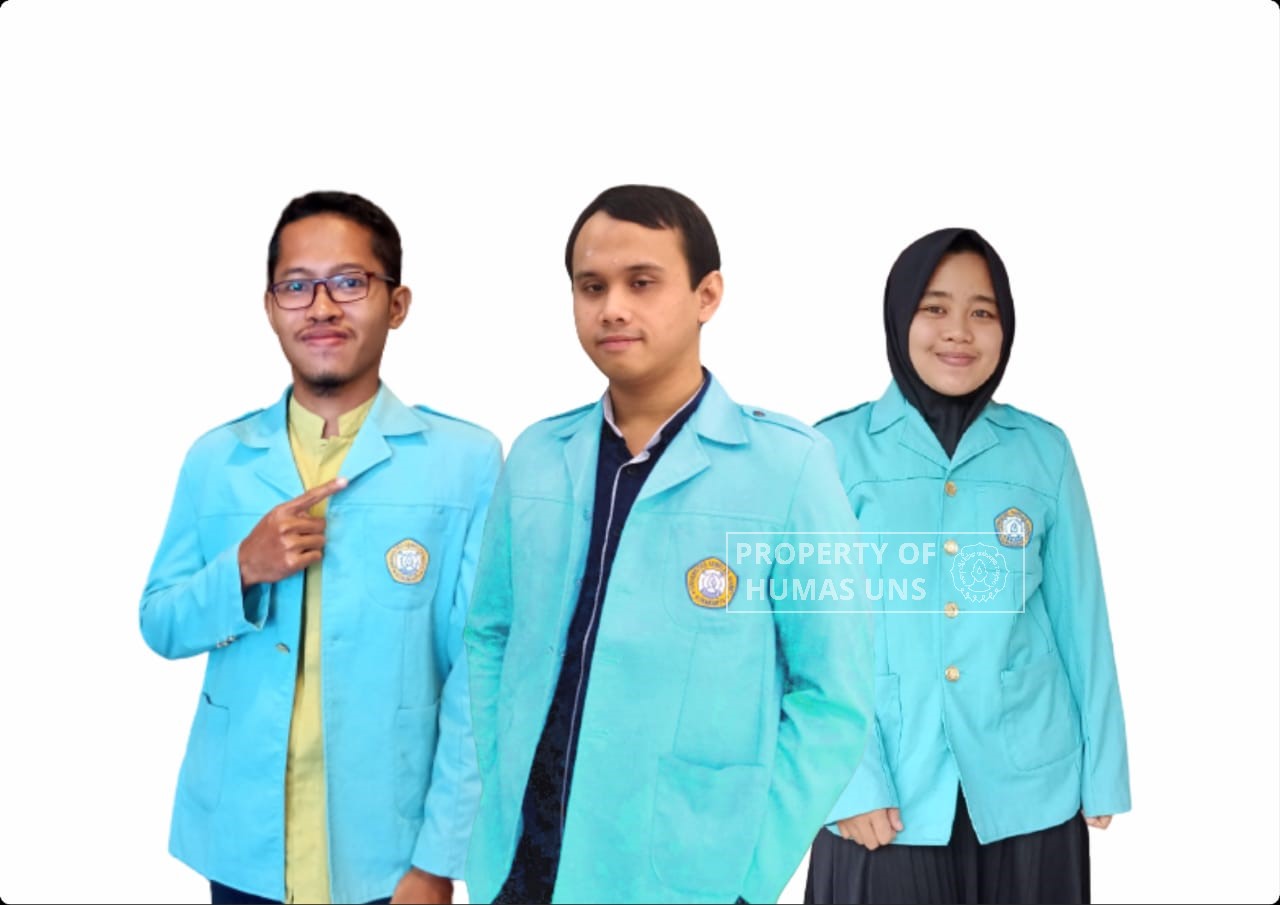
UNS — One of Student Creativity Program for Exact Research (Program Kreativitas Mahasiswa Penelitian Eksakta – PKM-PE) teams from Universitas Sebelas Maret (UNS) Surakarta created an innovation by utilizing Common Water Hyacinth (Eichhornia crassipes) and Red Ginger as hydrogel plaster to cure Diabetes Mellitus (DM) wounds infected with MRSA. This team was supervised by Dr.rer.nat. Maulidan Firdaus, M.Sc, has three members, Muhammad Iqbal Daniswara, a student of Chemistry Program 2017, Khoirul Jamaluddin, a student of Chemistry Program 2016, and Novi Andriani from Diploma Program (D3) of Pharmacy 2018.
To uns.ac.id, the Team Leader, Muhammad Iqbal Daniswara explained that this innovation comes from abundant natural cellulose fiber. Common Water Hyacinth consists of 60% cellulose, which makes it a good material for hydrogel. However, hydrogel only helps to close wound without preventing the growth of microorganisms, which is why it is necessary to add an antibacterial agent. Red Ginger is one of the candidates for an antibacterial agent. Research has found that Red Ginger has an antibacterial activity that can kill Methicillin-resistant Staphylococcus aureus (MRSA). MRSA or methicillin-resistant staphylococcus aureus is an infection caused by Staphylococcus aureus bacteria. Staphylococcus aureus has five times the potential to infect DM wounds. This infection might cause the diabetic wound to worsen, and without prompt treatment, the patient will need to get an amputation
“The increasing number of people with diabetes is quite alarming. Untreated diabetes wounds can worsen their condition because of infection, especially by MRSA bacteria, which tend to live in damp places like skin. Therefore, we explored the information on the materials around us that have the potential to heal diabetic wounds,” Iqbal stated Tuesday (24/11/2020).
The data from World Health Organization (WHO) estimated that in 2025 the number of DM cases would go up to the fifth position (12.4 million people) from its previous seventh position in 1995 (4.7 million people).
“Hydrogel, which is biocompatible, has a better ability to cure wounds compared to the normal plaster. The antimicrobial agent is needed to increase its performance in killing bacteria. Red Ginger extract is found to hinder the growth of MRSA bacteria. By mixing Red Ginger extract in the hydrogel as plaster, this innovation has a potential to cure diabetic wounds and prevents infection,” Iqbal explained.
Further literature review shows no comprehensive report on Common Water Hyacinth cellulose’s potential and the antibacterial agent from Red Ginger as diabetic wound plaster. This PKM aims to examine the possibility of Common Water Hyacinth cellulose as the raw material of hydrogel, and Red Ginger rhizome as an antibacterial agent as a new alternative to diabetes mellitus wound healing plaster. This PKM-PE also won funding from PKM 2020 grant from Kemdikbud RI and passed to join the National Student Science Week (Pimnas) 2020. Concerning this achievement, Iqbal and the team hope that they can bring the best result and bring home a medal. Humas UNS
Reporter: Dwi Hastuti