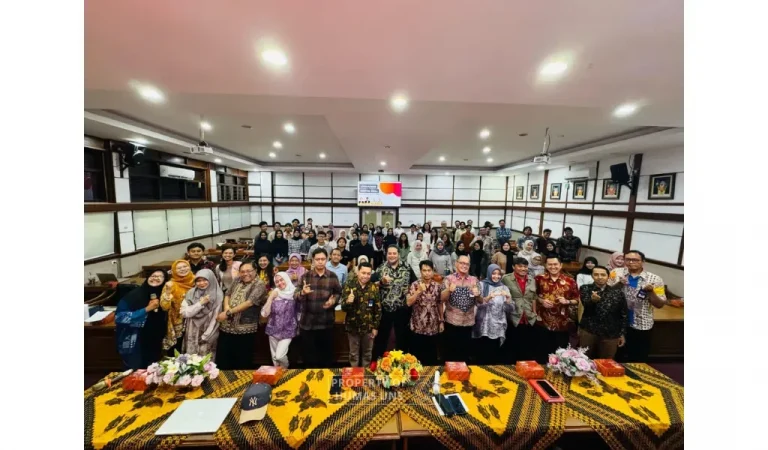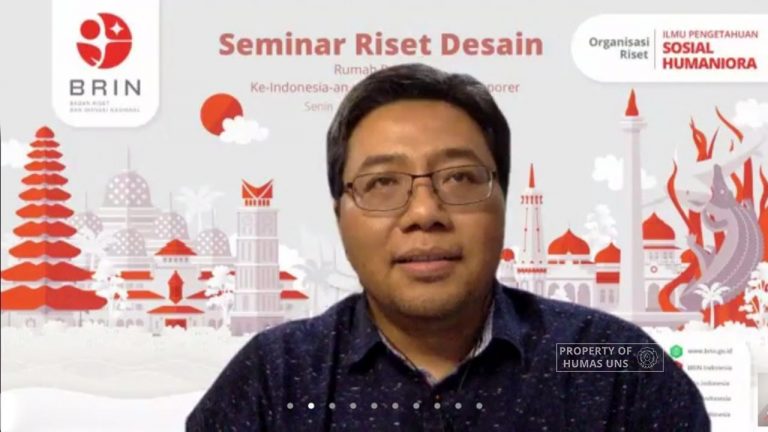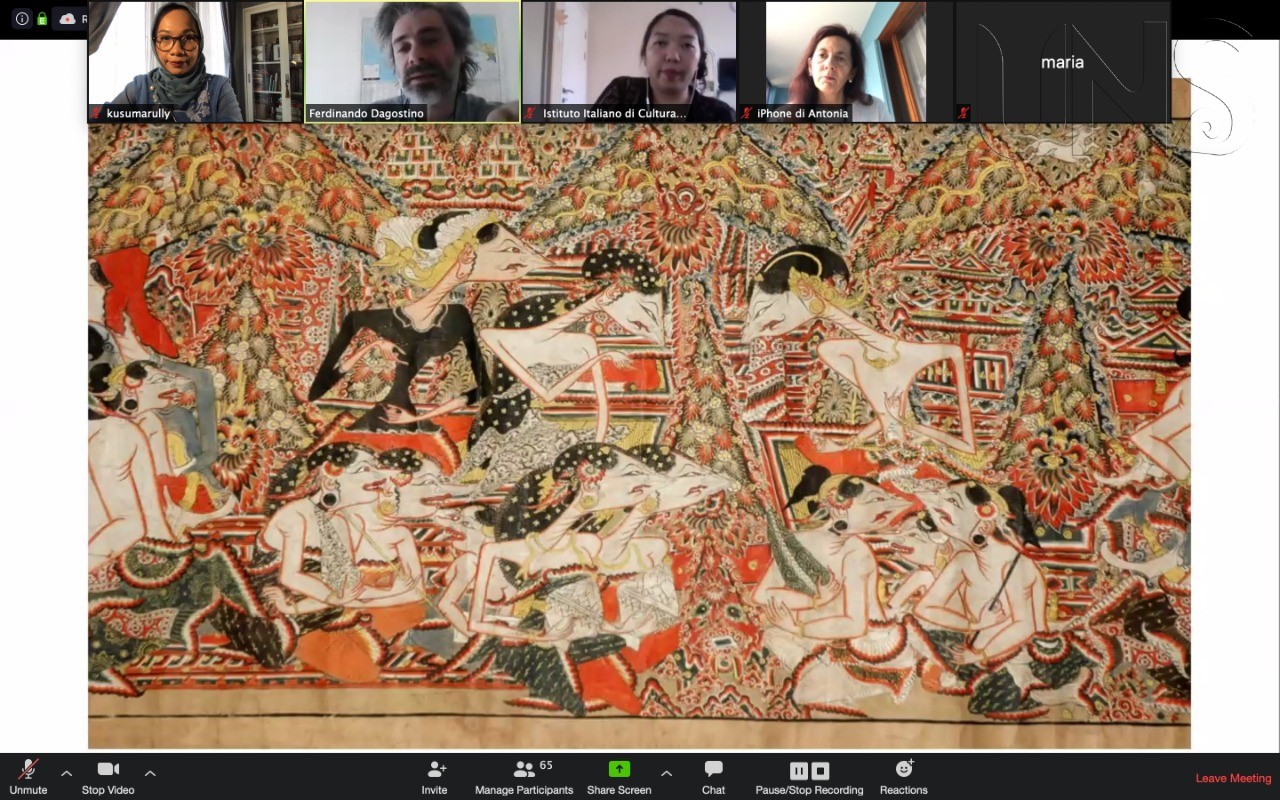
UNS – The Urban-Rural Design and Conservation Laboratory (URDC Labo) Architectural Engineering Program, Faculty of Engineering (FT) Universitas Sebelas Maret (UNS) Surakarta in partnership with the Istituto Italiano di Cultura Jakarta (Italian Cultural Institute) held a webinar entitled “Wayang Beber: The Space and Landscape Perspective and the Challenge of Regeneration” on Friday (15/5/2020).
The webinar invited two speakers: Ferdinando Dagostino, as a Doctoral Student at École des Hautes Études en Sciences Sociales – France and a member of Centre Asie du Sud-Est Laboratory-CASE. The second speaker is Dr. Ars. Avi Marlina, S.T., M.T, the head of Master in Architectural Engineering program FT UNS.
The event was guided by Dr. Eng. Kusumaningdyah N.H., S.T., M.T, aims to highlight how fundamental is the protection and conservation process of intangible cultural heritage. This effort is taken to preserve collective memories and to promote the intangible culture of an area. Cultural potential becomes a potential resource when supported by sustainable development in various sectors, among others in economic, social inclusion, and ecological balance.
The opening remark was provided by the Head of Architectural Engineering Program FT UNS Dr. Ir. Untung Joko Cahyono M. Arch. Dr. Untung conveyed that this webinar was expected to broaden participant’s knowledge about culture, especially for students.
“In this pandemic, many events are canceled including cultural events. Hopefully, this webinar can widen our cultural knowledge,” Dr. Untung stated.
Maria Battaglia, the Director of Italian Cultural Institute Jakarta as well as The Cultural Attaché of the Italian Embassy to Indonesia also added that at the time of a pandemic, we needed more art and cultural intake than usual. Art and culture have a role as a comforter and unifier.
The first speaker, Ferdinando Dagostino, an Italian researcher who since 2008 has researched Wayang, especially Wayang Beber since 2014, discussed some elements of the landscape, the use of space, spatial perspective, and their role in creating feelings and moods in Wayang Beber. He also explained briefly about the origins of the Wayang Beber and its development to date. As well as the visual elements of Wayang Beber sheet which is considered as a marker of space and shows the absence of focal points and perspectives in Wayang Beber.
Further, Dr. Avi reviewed the efforts taken in the conservation process of Wayang Beber which is not widely known by young people today as intangible cultural heritage.
“Many Javanese people do not know what is Wayang Beber, moreover the young generation, it is necessary to educate them,” explained Dr. Avi.
Dr. Avi also explains how architectural design skills can assist in developing Wayang Beber. Together with architectural students, conducting a workshop on Wayang Beber design to several Senior High School (SMA) in Surakarta. Senior High School is selected because school children are familiar with style and color. “Senior High School students are familiar with styled or colored things.” Dr. Avi said. The workshop is expected to add to student’s knowledge and ability in drawing and regeneration of coloring skills to preserve this heritage.
The webinar was attended by 130 participants, both through Zoom platform and YouTube streaming. Aside from participants who came from various cities in Indonesia (Jakarta, Solo, Bandung, Surabaya, Padang, Pasuruan, Borneo, etc.), participants also came from Italy, (several representatives from Orientale in Napoli), from France (a representative from CASE), from Croatia, and Japan. The participants actively participate in the questions and answers session. Humas UNS/Zalfaa