UNS — Democracy and National Resilience Study Center (Pusdemtanas) Institute of Research and Community Service (LPPM) Universitas Sebelas Maret (UNS) Surakarta invited the Chief of Association of Procedural Law Teachers of the Constitutional Court (Asosiasi Pengajar Hukum Acara Mahkamah Konstitusi – APHAMK) from various regions as speakers in online discussion ‘Where to go with the Revision of the Constitutional Court Law’ on Wednesday (5/8/2020), through Zoom Cloud Meeting. The speakers are Dr. Zahratul Idami as the Chief of APHAMK Aceh, Muhammad Asyikin, S.H., M.H. as the chief of APHAMK Maluku Utara, Dr. I Gede Yusa as the Chief of APHAMK Bali and Dr. Muhtadi as the Chief of APHAMK Lampung.
As the main speaker, Dr. Zahratul delivered her material on ‘The Fundamental Problem in the Revision of Constitutional Court Law and Solutions”. In front of the webinar participants, she discussed several changes in the second amendment. The important materials in Legal Draft for the Second Amendment to the Law Number 24 of 2003 concerning Constitutional Court includes the election of Chairman and Deputy Chairman of Constitutional Court, requirements of Constitutional Court Judge, and dismissal of Constitutional Court Judge and the limit of judge retirement age. Dr. Zahratul also noted other important points that have not been included in the Constitutional Court Law Amendment, one of which is the testing of the current legal draft by the Supreme Court. She also discussed procedural law on Article 32 concerning the requests for completeness are also not included in the amendments, including submitting a copy of the application.
Adding to the explanation from Dr. Zahratul, the Chief of APHAMK Maluku Utara, Muhammad Asyikin, S.H., M.H., mentioned that the root of the problem of Constitutional Court Law amendment is Article 24C UUD 1945. He considers that the selection of Constitutional Court Judge tends to be troublesome because the process involves three state institutions as proposers.
“The amendment of Constitutional Court Law has no intention to strengthen Constitutional Court as a judicial institution because the arrangement on the judge selection is very complicated because it needs to be proposed by DPR (house of representatives), President, and MA (supreme court). There should be a special institution that regulates the selection of MK Judges. Currently, there will be a political reciprocation which makes MK lose the spirit that people who seek justice,” Muhammad Asyikin, S.H., M.H. explained.
In the online discussion, he also highlighted the tenure for Constitutional Court judges. He stated that ideally, Constitutional Court judges serve for 10 years with a consideration that judges will develop the mature psychological condition and that they can act as a good statesman. The tenure for Constitutional Court judges was also discussed by Dr. Muhtadi, who deplored that the new amendment did not regulate the age limit for the Constitutional Court judges.
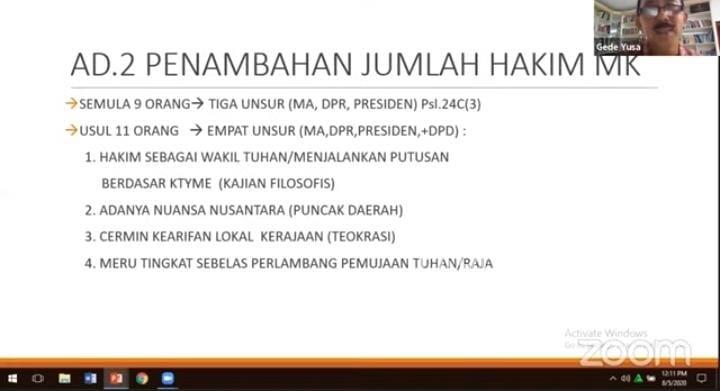
Another speaker, Dr. I Gede Yusa, in the presentation on ‘The Addition of Constitutional Court Age and Number to Enforce the Final and Binding Legal Ruling’ stated that the age limit can affect the level of maturity of thought. However, he found that the final and binding rulings from the Constitutional Court are not followed by DPR, President, and other state institutions. Therefore, to solve this problem, he provided three solutions, add the age limit for Constitutional Court judges, adding the number of judges, and improve the quality of MK rulings. Humas UNS
Reporter: Yefta Christopherus AS
Editor: Dwi Hastuti