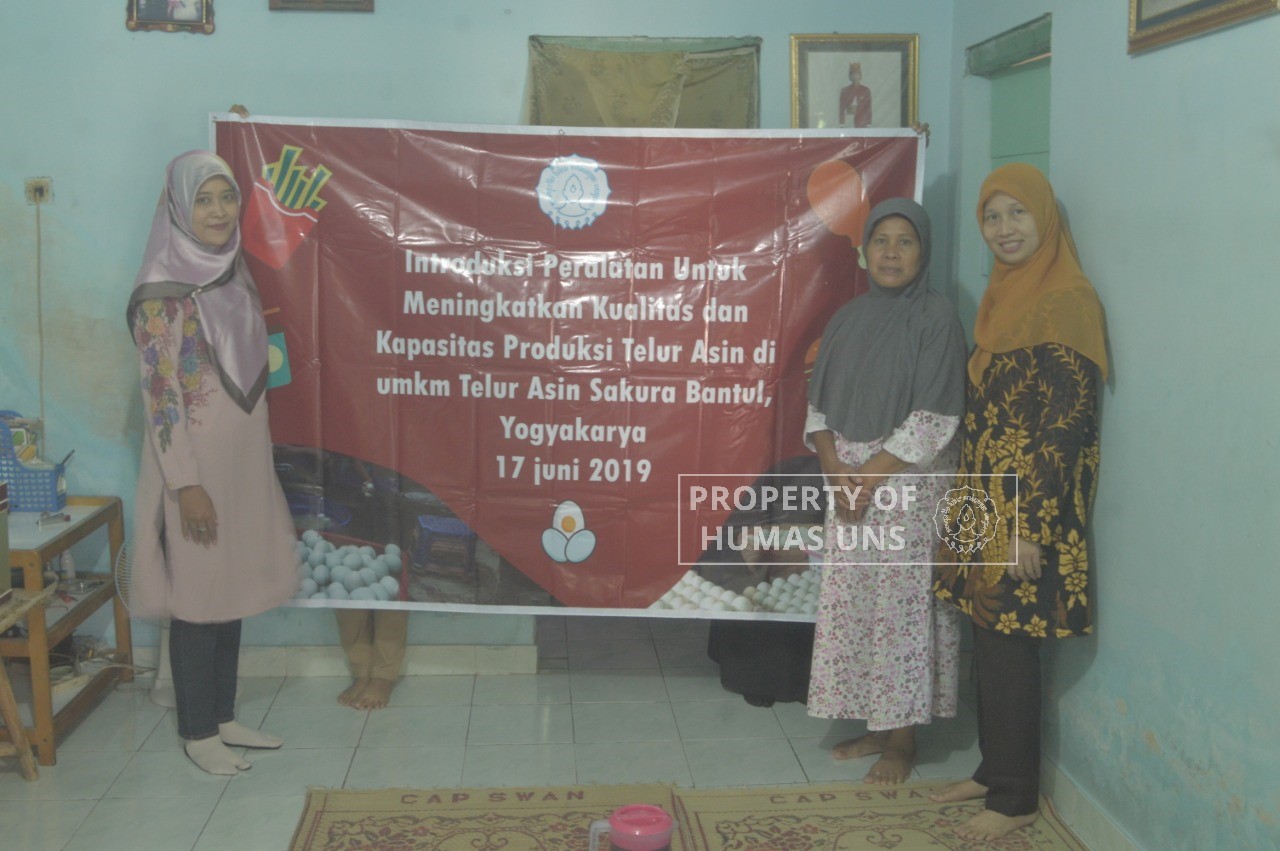
UNS — Do not stop at research and scientific journal, three Faculty Members from Food Technology Program (ITP) Faculty of Agriculture (FP) Universitas Sebelas Maret (UNS) Surakarta introduced their low sodium telur asin (salted egg) innovation to the Micro Small, and Medium Enterprise (MSME).
The team that consists of Dr. Setyaningrum Ariviani, S.T.P., M.Sc, Dwi Ishartani, S.TP, M.Si, and Gusti Fauza, ST, MT, Dr.Phil as members took the efforts to improve the quality, quantity, and diversification of “Telur Asin Sakura” products in Bantul, Yogyakarta.
Based on the news release received by uns.ac.id, there are weaknesses and constraints faced by “Telur Asin Sakura”. Among these weaknesses and constraints are the low product quality and short shelf life, weak product quality control, limited product variants, insufficient product packaging and no labeling, and marketing constraints.
“Before this, there is a limitation of production technology. Previously, “Telur Asin Sakura” is a business unit that produces salted egg traditionally,” Dr. Setyaningrum stated on Friday (29/1/2021).
For diversification or adding new product variants, the team conducted training for salted egg production with low sodium that is good for people with hypertension following Dr. Setyaningrum et al. study. This innovation focuses on the salting process by replacing sodium salt (NaCl) with potassium chlorides (KCl) and added teak leaves extract in the salting mixture. The eggs are then put into the oven under 100°C temperature for 30 minutes. Therefore, the oven is also introduced as production equipment.
There is an improvement in salted egg products. The yolk has better color, better texture, less microbial contamination, lower sodium content, and longer shelf life. “There is also a new product variant with low sodium salted egg,” Dr. Setyaningrum said. Besides the innovation in the production process, “Telur Asin Sakura” also received assistance in formulating the Standard Operating Procedure (SOP), the introduction of packaging and labeling, and online marketing.
Finally, “Telur Asin Sakura” product is packaged and labeled and has an online website. The production capacity of “Telur Asin Sakura” increased by 2.5 times and sales increased by 48%. This innovation is an improvement considering salted egg is a preservation product for duck egg rich in unsaturated fatty acids, protein, and minerals and have lower levels of phospholipids and cholesterol than fresh eggs.
“Our community service activity provides a solution for the problems faced by “Telur Asin Sakura”,” Dr. Setyaningrum concluded. Humas UNS
Reporter: Kaffa Hidayati
Editor: Dwi Hastuti