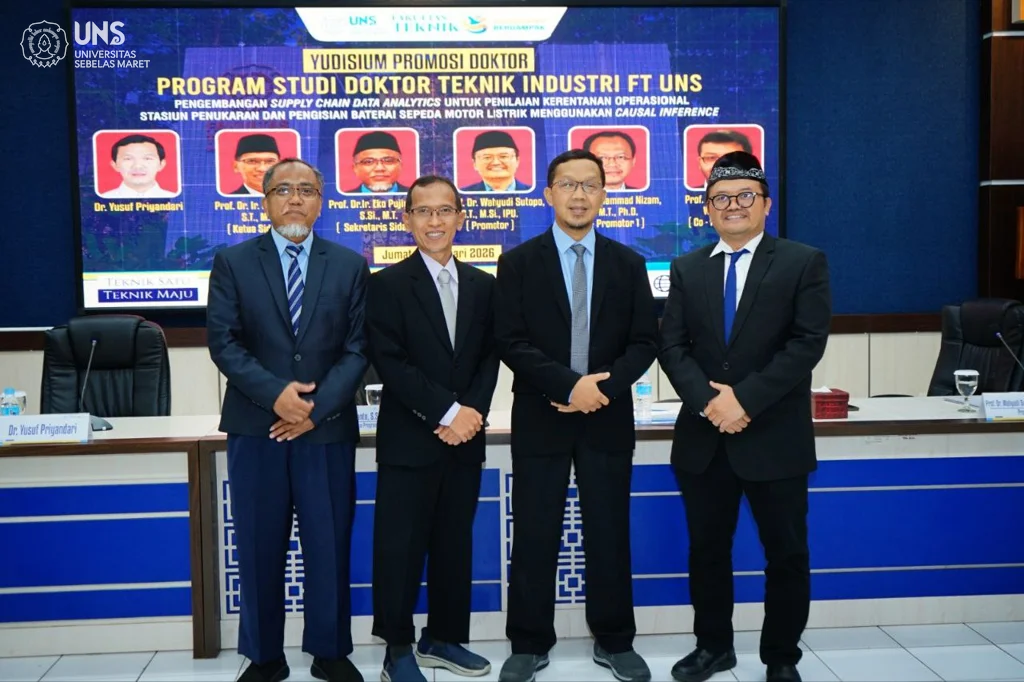
UNS — Universitas Sebelas Maret (UNS) Surakarta doctoral student from the Industrial Engineering Doctoral Program, Faculty of Engineering (FT), Yusuf Priyandari, successfully earned his doctoral degree through research on Big Data Analytics–Causal Inference in the Electric Motorcycle Battery Swap and Charging Station (EM-BSCS) system.
His research introduced a new approach to measuring operational vulnerability based on large-scale data and revealed causal relationships among factors contributing to vulnerability, enabling better monitoring of operational issues in EM-BSCS systems.
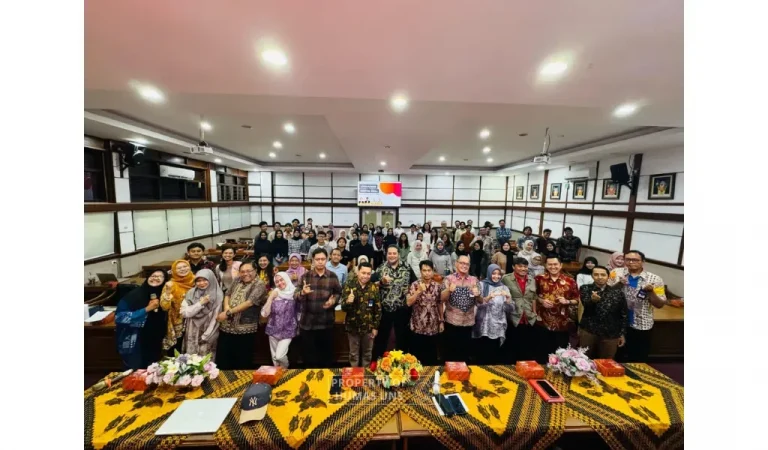
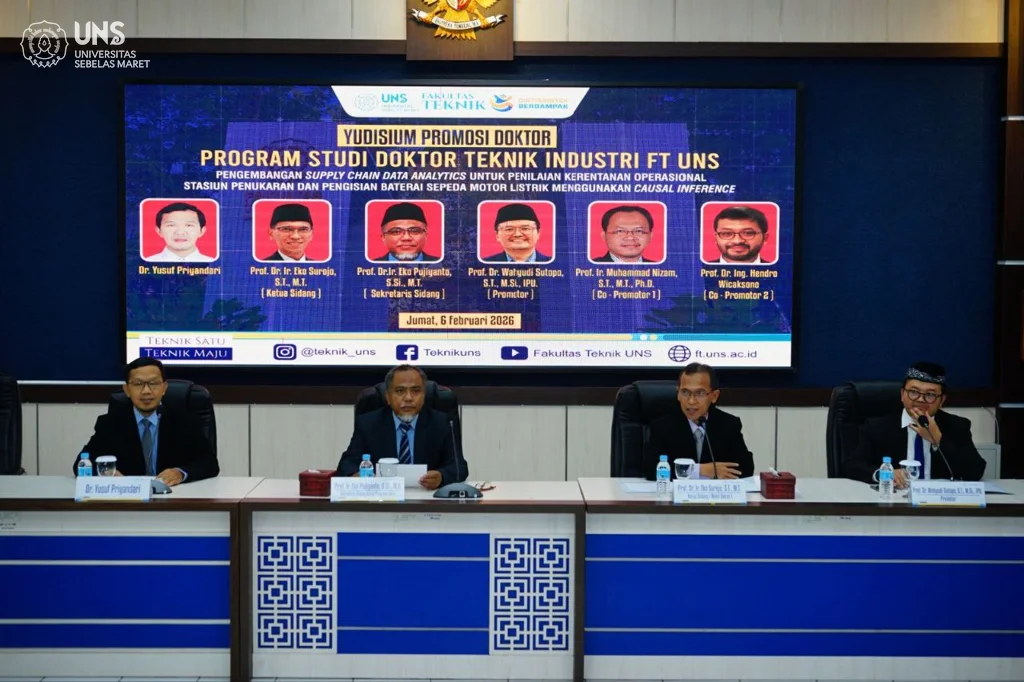
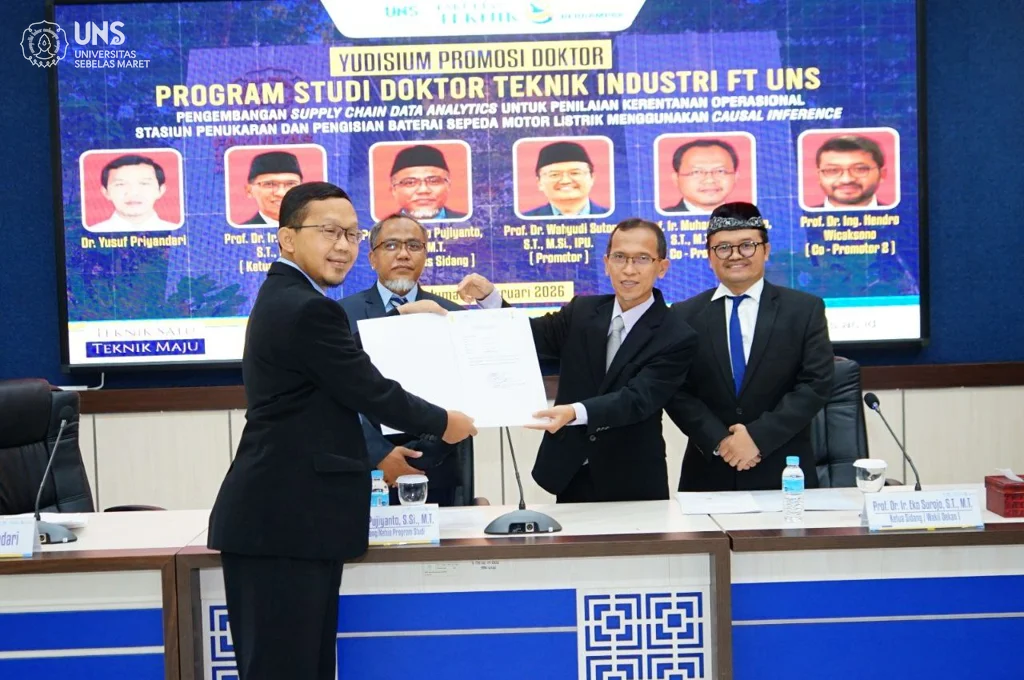
Following his doctoral promotion yudisium held at the Multimedia Room, Building 4, Faculty of Engineering UNS, on Friday (6/2/2026), Yusuf explained that the research was motivated by the operational complexity of battery swapping and charging services, technical disruptions, and environmental influences that may create operational vulnerabilities. These vulnerabilities can lead to decreased performance, increased risk, and reduced consumer trust.
The first outcome of the research was the development of an outcome-based vulnerability metric model that measures deviation, duration, frequency, and performance deterioration of stations, as well as a vulnerability metric based on the characteristics of the battery swapping and charging system itself. These metrics were then aggregated into a station vulnerability score.
The station vulnerability score and its component scores were used to classify the operational condition of each station into one of five categories: not vulnerable, potentially vulnerable, moderately vulnerable, vulnerable, and highly vulnerable. This model can support EM-BSCS management companies in continuous monitoring and mitigation decision-making through an Internet of Things (IoT)-based dashboard platform.
“The monitoring results of 124 station points in Jakarta over three months in 2023, based on more than 880,000 battery swapping and charging transaction data records from an EM-BSCS operator, showed that most stations were not vulnerable, while the rest were only potentially vulnerable. This finding gives positive assurance for electric motorcycle users to confidently use battery swap and charging services,” Yusuf explained.
The research also produced an operational disruption monitoring scheme through an IoT dashboard platform by classifying disruptions into four types: offline stations, unreadable or stuck batteries, cabinet door issues, and connector plug damage.
Based on 1,595 disruption records analyzed, offline stations were the most dominant issue (61%), followed by battery detection failures, cabinet door problems, and connector disruptions. Customer-reported disruption descriptions could be automatically processed into disruption type information using a retrieval-based classification model from the Beijing Academy of Artificial Intelligence (BAAI) with the Beijing General Embedding (BGE) method.
This automation helps companies accelerate disruption handling decisions and improve customer service quality.
Another major output of the research was a causal effect estimation model for factors contributing to vulnerability changes in each station. This included a Structural Causal Model (SCM) in the form of a Directed Acyclic Graph (DAG) that maps cause-and-effect relationships among vulnerability factors.
Using do-Calculus and Double Machine Learning on large-scale empirical transaction data, the study enabled the estimation of average vulnerability score changes caused by changes in specific contributing factors.
One of the findings indicated the importance of regulating the number of active cabinets, as it significantly affects vulnerability levels along with other factors such as cabinet technical failures and station downtime. Another finding showed that each station has unique vulnerability effects, making the model highly valuable for developing recommendation systems within the company’s IoT dashboard platform.
Overall, the study emphasizes that utilizing large-scale data stored in IoT platforms is crucial for sustainable operational vulnerability monitoring in electric motorcycle battery swapping and charging stations. Additional external environmental data around station locations would further improve vulnerability estimation through vulnerability metrics and causal inference models.
“With this, we hope mitigation steps taken by companies can become more effective. In addition, the automated disruption classification model we developed, if implemented in the IoT dashboard platform, will help companies monitor disruption distribution and handle problems more efficiently,” Yusuf added.
Yusuf, who is also a lecturer in the Industrial Engineering Study Program at UNS, completed his dissertation under the supervision of a promoter team consisting of Prof. Dr. Ir. Wahyudi Sutopo as Promotor, Prof. Ir. Muhammad Nizam as Co-Promotor I, and Prof. Dr.-Ing Hendro Wicaksono from the School of Business, Social and Decision Sciences, Constructor University, Germany.
Prof. Wahyudi Sutopo stated that the dissertation resulted in three scientific publications presented at international conferences including IEOM Australia, Sydney 2022, and the 4th Asia-Pacific Conference in Ho Chi Minh City 2023, as well as publication in the Q1 international journal Scientific Reports by Nature Research in 2025.
These works enrich the field of industrial engineering, particularly in supply chain management, information engineering, and quality engineering, through the development of supply chain analytics integrating big data and causal inference to assess and manage closed-loop supply chain vulnerabilities based on digital services.
“Dr. Yusuf Priyandari achieved an outstanding academic record with a GPA of 3.96 and graduated with the distinction of very satisfactory,” he concluded.
HUMAS UNS