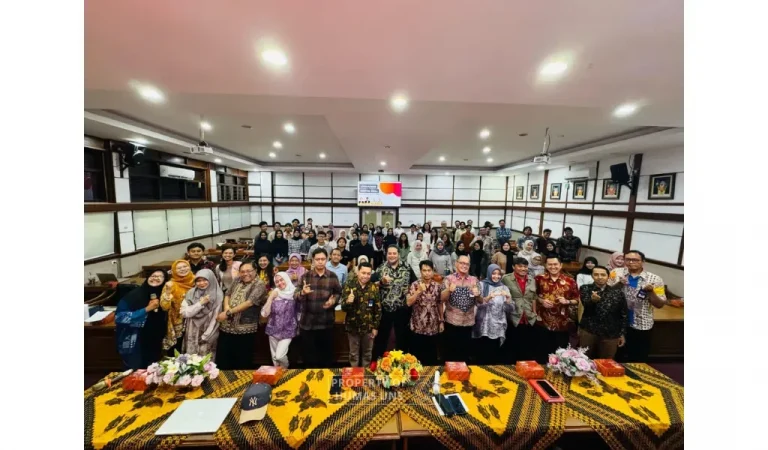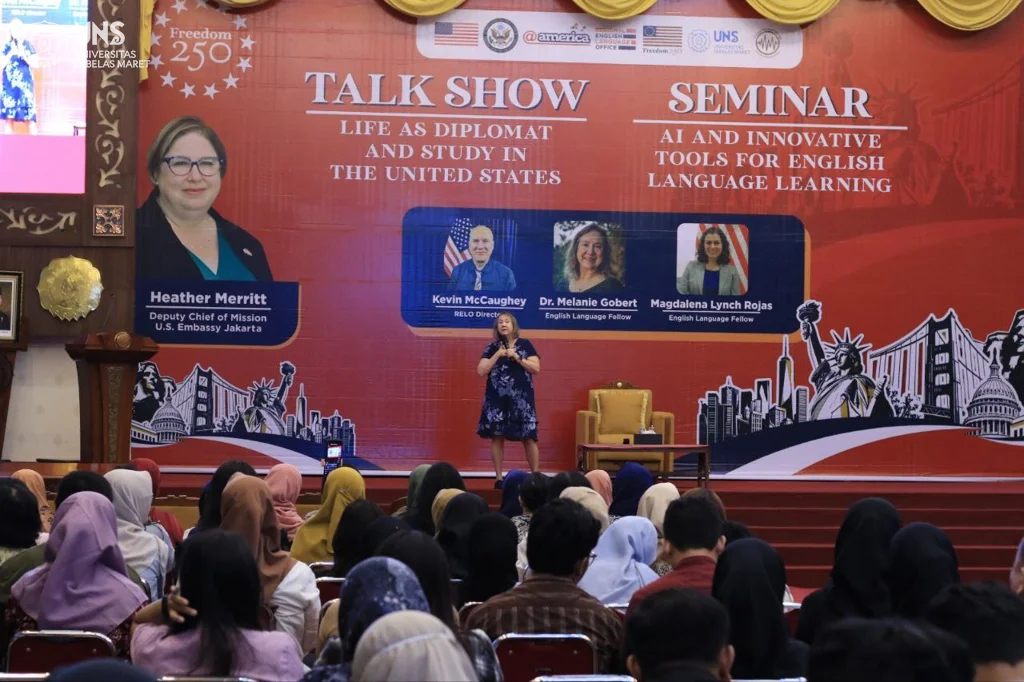
UNS — Universitas Sebelas Maret (UNS) Surakarta hosted the seminar titled “AI and Innovative Tools for English Language Learning” on Friday (6/2/2026) at the G.P.H. Haryo Mataram Auditorium. The event featured three speakers from the Embassy of the United States, Jakarta and was attended by members of the UNS academic community as well as English teachers from the Solo Raya region.
The three speakers delivered different yet interconnected topics focusing on the role of Artificial Intelligence (AI) in education, particularly in English language learning. The first session, titled Beyond the Algorithm: Human Interaction in the Age of AI, highlighted the importance of maintaining human interaction in the learning process despite the growing presence of AI in classrooms.
Kevin McCaughey, RELO Director, explained how AI can serve as an effective support tool for language teachers. AI can assist with technical tasks such as explaining grammar, preparing lesson plans, correcting students’ writing, and even functioning as a language tutor. It can also help with administrative work, allowing teachers to save time and focus more on the learning process itself.
However, Kevin emphasized that AI has fundamental limitations when it comes to human interaction. AI cannot manage classroom dynamics, build shared attention, encourage physical engagement, or transform information into collective action. In real classroom settings involving 15 to 100 students, the teacher’s role remains essential in managing social energy and maintaining student engagement.
Through examples of simple learning activities without technology, he demonstrated that minimal learning tools can actually encourage active student participation. Teachers are encouraged not only to teach language as knowledge, but also to create opportunities for students to explore language as a practical skill.
“In this context, AI should be positioned as a supporting tool, while human interaction remains at the center of learning,” Kevin explained.
The second session, Using AI Tools for Academic Writing, was presented by Dr. Melanie Gobert, who discussed the use of AI in supporting academic writing. AI can help lecturers and students in drafting, editing, and finding references, especially when dealing with language barriers, time constraints, and international publication demands.
Nevertheless, Melanie warned about several challenges in using AI for academic writing, including fabricated references, language and cultural bias, limited access to technology, and issues related to ethics and academic integrity. Participants were encouraged to remain critical and avoid using AI-generated results without proper verification.
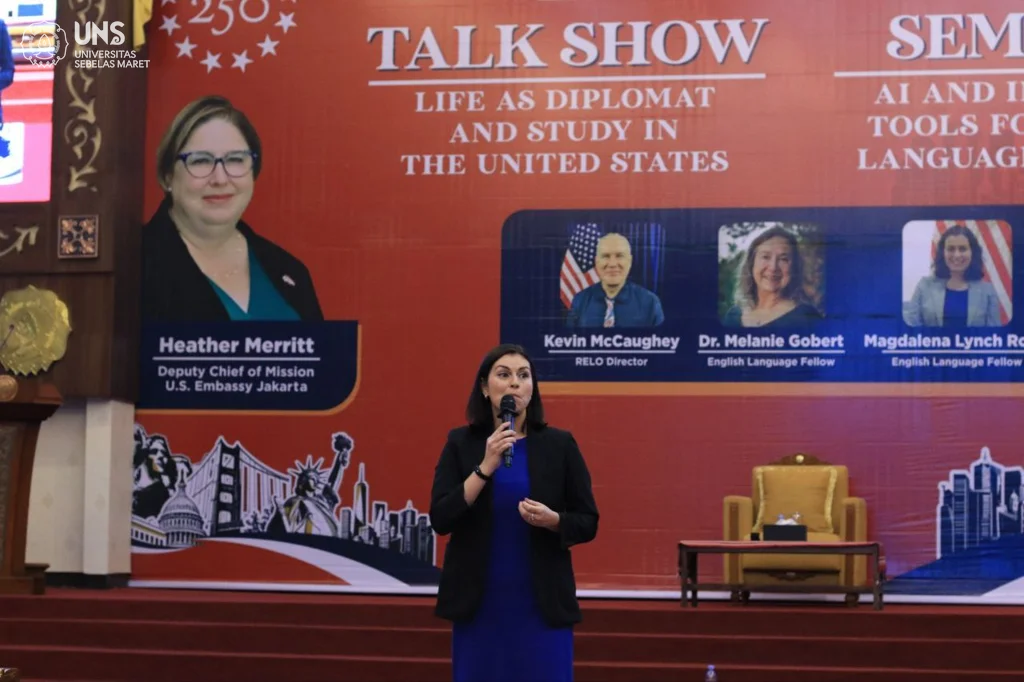

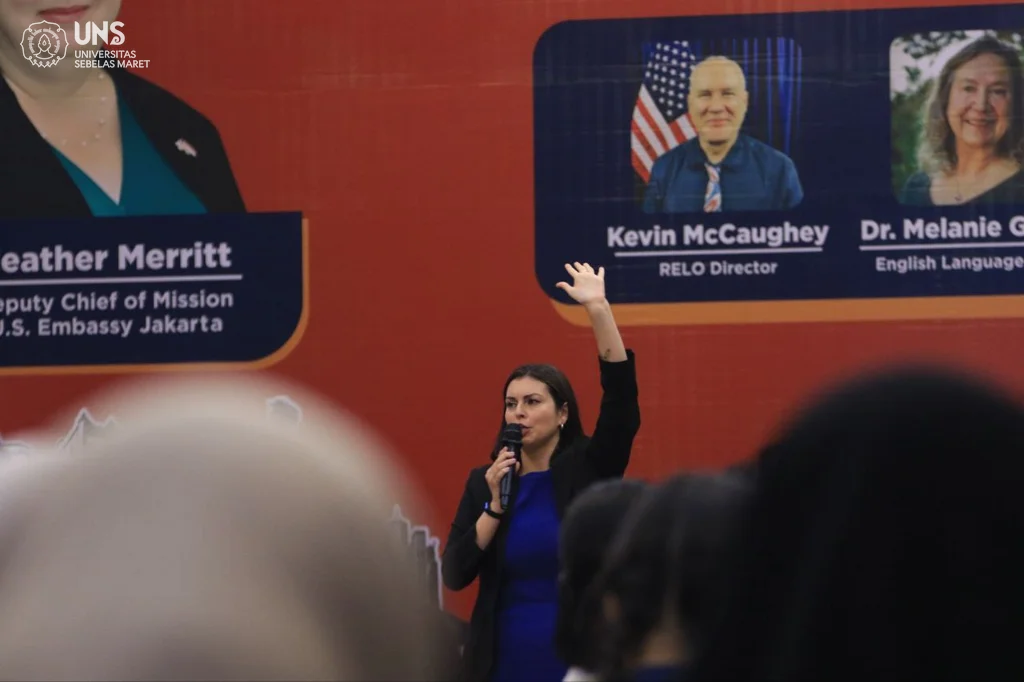
During the session, several AI tools such as ChatGPT, Gemini, and Microsoft Copilot were introduced, along with their respective strengths and limitations. Melanie emphasized the importance of responsible AI usage, including checking journal policies, verifying the validity of references, and disclosing AI use when required to maintain honesty and academic quality.
The final session, Picture Your Progress: Using Vision Boards to Motivate and Practice English, was led by Magdalena Lynch Rojas. She introduced vision boards as a creative and motivating medium for English language learning. A vision board is a collection of images and words representing students’ hopes and future goals.
Magdalena explained that visualization has a scientific basis in helping individuals achieve their goals. By imagining their dreams concretely, students become more motivated and committed to both academic and personal aspirations.
In language learning, vision boards help students practice vocabulary, sentence structures, and expressions related to future plans such as education, careers, and places they wish to visit.
The activity involved creating vision boards manually or digitally, followed by a gallery walk where students observed each other’s work, gave comments, and engaged in discussion.
“This method has proven effective in increasing students’ confidence, learning motivation, and English communication skills. In addition, teachers can better understand students’ interests and life goals,” Magdalena said.
Through this series of sessions, the seminar reaffirmed that technology, including AI, is a valuable educational tool. However, human interaction, creativity, and the teacher’s role remain the main foundation for creating meaningful and sustainable learning experiences.
HUMAS UNS