UNS — Tobacco control or tobacco products control has drawn people’s attention for a long time. Besides its impact on health and the environment, this product also poses a socio-economic impact on the community. This issue encourages Business Communication Institute London School of Business (IKB LSPR) Jakarta to held Community Services Program for Multi-Campus Academics in Communication Science. IKB LSPR invited 15 academicians in the Communication Science field from 15 campuses in Indonesia to educate university students on this issue. The Communication Science Program of the Faculty of Social and Political Sciences (FISIP) Universitas Sebelas Maret (UNS) Surakarta are among the invited institution to participate in the program.
Dr. Lestari Nurhajati, the program coordinator, quoting the document of Basic Research on Health (Riskesdas), said that the number of active smokers in Indonesia in the age of 15 years old and above is 33.8% of the total population of around 65.7 million people. This data placed Indonesia as the largest cigarette market in the world after China and India.
“Some children have started smoking from their elementary school years. Sadly, the policy that controls tobacco usage in Indonesia is very weak. The regulation on cigarette ads, for example, is still on the partial level and not a comprehensive restriction,” she explained from Tobacco Atlas data in 2020 on Wednesday (11/3/2021).
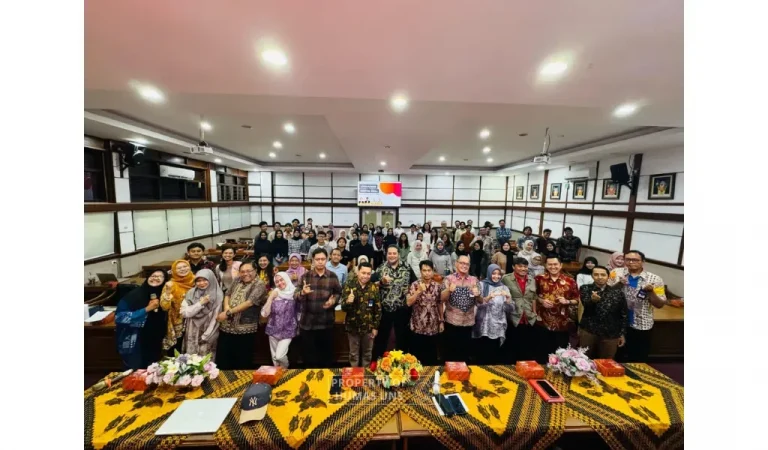
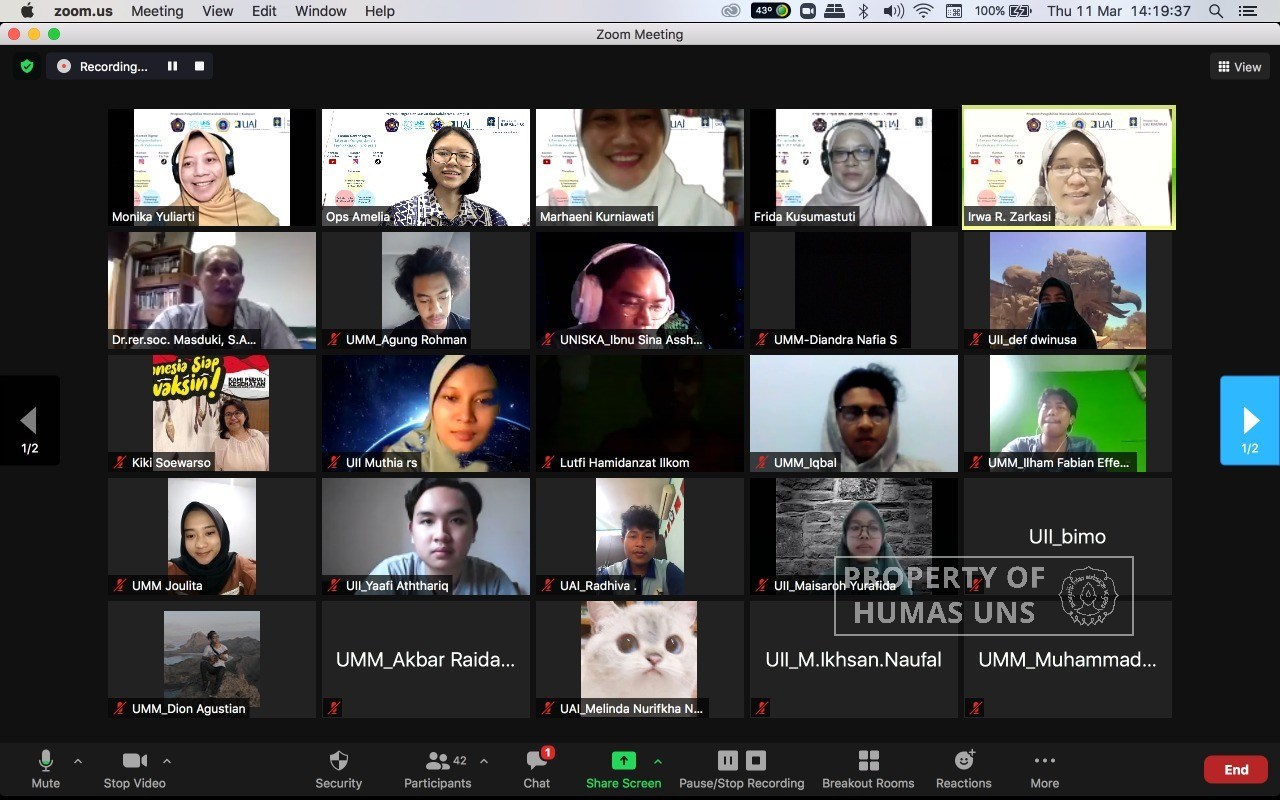
The invited Faculty Members from 15 campuses are divided into three groups and were tasked to conduct real tobacco control action. Team 2 that consists of five universities, starts their program by providing supervision to students that aim to increase students’ critical awareness that as the young generation, they are the key market target for tobacco products and become potential continuous smokers. “Students involved in this event are from UNS, Universitas Muhammadiyah Malang (UMM), Universitas Islam Muhammad Arsyad AlBanjari (Uniska) Banjarmasin, Universitas Al-Azhar Indonesia (UAI) Jakarta, and Universitas Islam Indonesia (UII) Yogyakarta,” Dr. Frida Kusumastuti from UMM as Team 2 Leader explained.
They hope that the briefing will encourage students to create digital contents on social media platforms to share the facts surrounding tobacco products and their effect on Indonesian society’s health and socio-economic condition. The briefing led by Dr. Marhaeni Fajar from Uniska Banjarmasin shared the material on the industrial facts of tobacco written by Dr. Masduki from UII and the facts surrounding adolescence and social media regarding tobacco products from Dr. Irwa Zarkasy from UAI Jakarta. This program’s output is digital content submitted for the competition and will be supervised by Monika Sri Yuliarti, M.Si. from UNS as the chairman of the jury.
“The competition will choose the best work based on the content and creativity, and favorite works based on social media likes. The competition will use three platforms, Instagram, YouTube, and TikTok,” Monika, who taught an Advertising course in Communication Science Program FISIP UNS, explained. Humas UNS
Reporter: Bayu Aji Prasetya
Editor: Dwi Hastuti