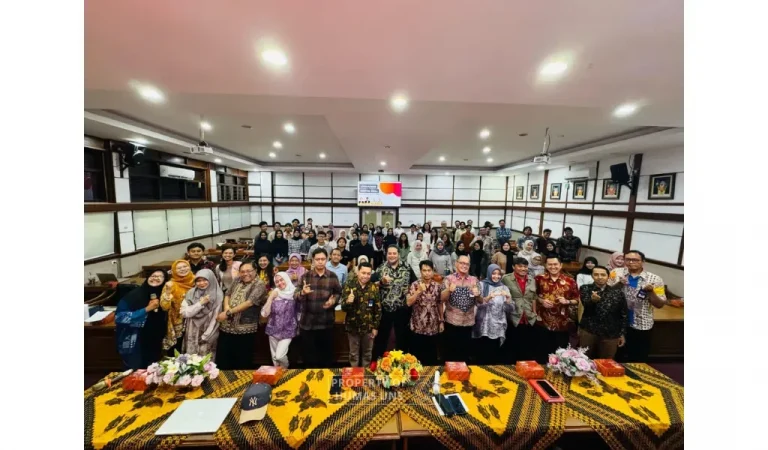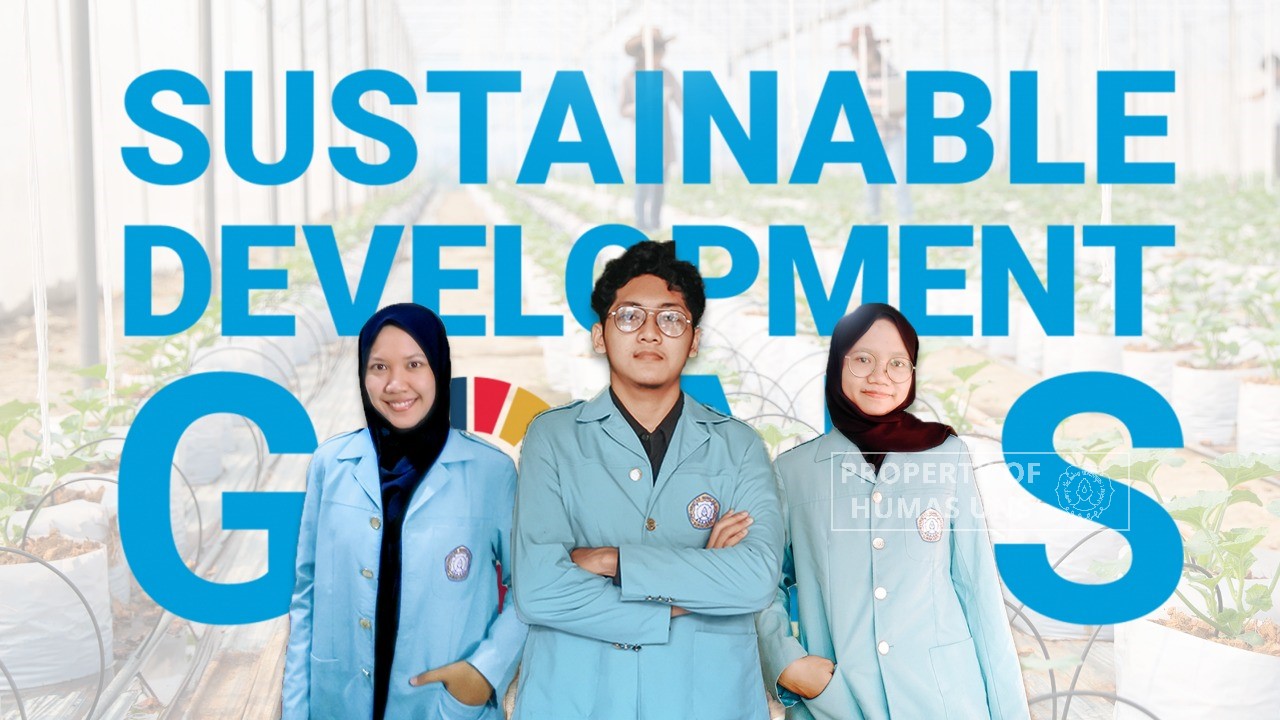
UNS — Students from the Faculty of Agriculture (FP) Universitas Sebelas Maret (UNS) Surakarta in the Semar Clean Up Team won the first position in the Creative Video Competition of Greeneration 2020 series. The team consists of Alifiati Saifira Salma (Agrotechnology 2017), Rr Ilma Kusuma Wardani (Agricultural Extension & Communication 2017) and Pandu Pramana Atmaja (Food Technology 2018), under the supervision of Bara Yudhistira, S.T.P., M.Sc, a Faculty Member of Undergraduate Program in Food Technology FP UNS. The national competition was held by the Association of Environmental Engineering Students UPN Veteran Yogyakarta on 5 November 2020 and was open for Senior High School and university students all over Indonesia.
One of the team members, Rr Ilma Kusuma Wardani stated that the 7 minutes video that they made raised the theme of Sustainable Development Goals (SDG’s). “Semar Clean Up Team formulates a concept of a waste-free irrigation system by utilizing microbes to degrade plastics as an effort in achieving the sixth SDG point, to ensure availability and sustainable management of water and sanitation for all,” Ilma explained, Wednesday (11/11/2020).
Ilma and team hope that in the future the innovation that they created will inspire the local community to continue to develop a waste-free irrigation system. The team supervisor, Bara Yudhistira, S.T.P., M.Sc added that the idea in the video was based on the growing waste issues. The video focused on plastic wastes because it is hard to be degraded naturally. Thus, a method to accelerate the breakdown of plastic waste needs to be introduced. This is increasingly important considering many community members still dispose of their waste to the bodies of water, such as rivers.
The microbe method is expected to be a sustainable system to be implemented because it employs a living organism which can be renewed anytime. The application of microbes is environmentally friendly because it does not employ synthetic chemical which has the potential to disturb the ecosystem in the bodies of water or river. Bara added that the main objective of this method is to provide clean water and sanitation according to the SDG but more than that many other impacts will benefit the society. One of which is degrading wastes which will decrease the volume of wastes in the rivers that may cause a blockage.
“Our next hopes are hopefully this concept can be applied not only for plastic wastes at the body of water but also for plastic wastes on the surface, such as at the landfill (TPA),” Bara explained. Humas UNS
Reporter: Dwi Hastuti
Editor: Dwi Hastuti