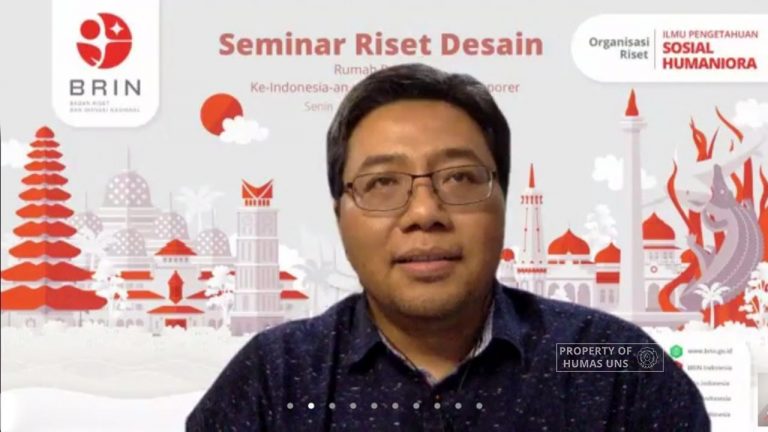
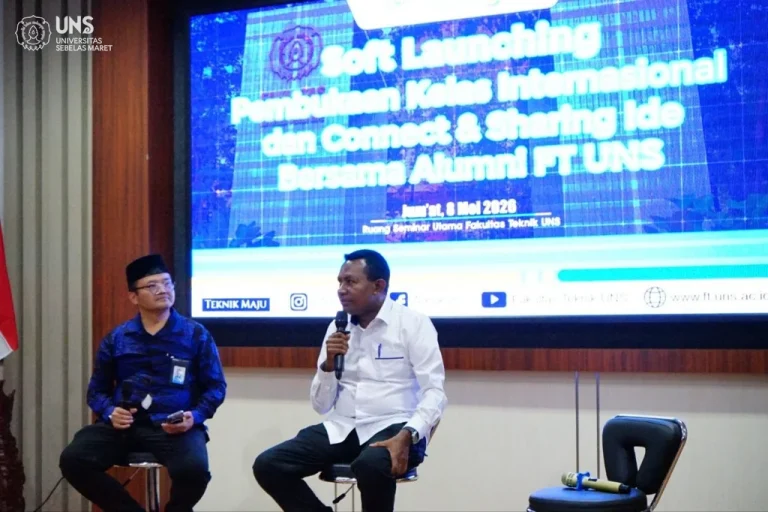
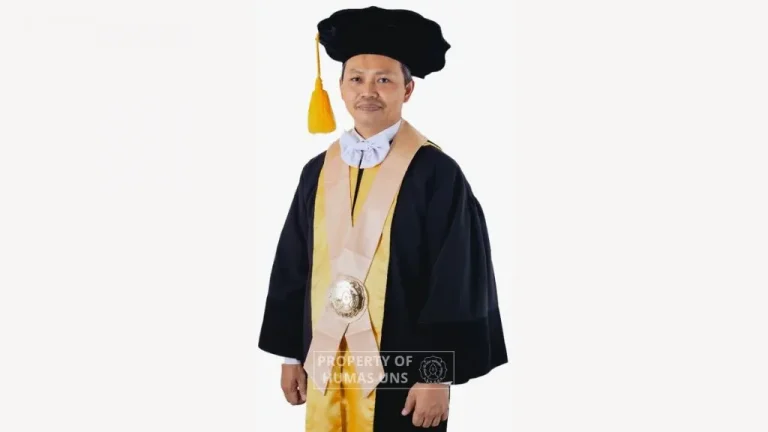
UNS – The Chairman of the Financial Service Authority (OJK) Board of Commissioner (DK), Prof. Wimboh Santoso, states that OJK is committed to reducing the Indonesia economic loss due to the ongoing COIVD-19 pandemic. This will be implemented by stabilizing the financial service sector, starting from banking, capital market, and other financial services sector. The statement was made during a webinar entitled ‘Countercyclical Policy for Financial Service Sector to Mitigate COVID-19 Pandemic’ organized by the Faculty of Economics and Business (FEB) Universitas Sebelas Maret (UNS) Surakarta, on Saturday (20/6/2020).
Prof. Wimboh who also serves as an Adjunct Professor for Risk Management Study FEB UNS explains that at the beginning the global investors had negatively reacted to SARS-CoV-2. They had predicted that this will directly affect a business person who issues debt securities or shares in the capital market.
“This leads to investor outflow, although the real sector is still okay, negative sentiments have emerged all over the world. Finally, the investors are selling their shares and transferred to gold,” explains Prof. Wimboh.
This negative sentiment was felt in Indonesia with the drop in the Indonesian Composite Stock Price Index (IHSG) in March. The stock trading in Indonesia Stock Exchange (IDX) had experienced a trading halt for 30 minutes twice due to a decline of more than 5%.
Prof. Wimboh explains that in accordance with the OJK Warrant No. S-274/PM.21/2020, the stock market will be suspended for 30 minutes if IHSG dropped for 5% or more. This serves as prevention to reduce a sharp fluctuation in the capital market.
“The worst impact was in March, IHSG, which usually reaches above 6,000 become less than 4,500 due to the negative sentiment in the capital market, thus, this becomes the first impact we felt. During a normal condition, stock trading will stop at a 7% level, but we took auto rejection 5% so the decline will not go rapidly,” he explains.
Aside from the stock market, the alumnus of the FEB UNS also mentioned that according to OJK Regulation No. 11/POJK.03/2020, the banking sector/financial service institution, whose customers cannot pay the installment, is provided a convenience to not set aside their capital temporarily. Therefore, the capital of the banking sector/financial institution is not reduced. The measure was taken by the FSA because many companies in Indonesia are experiencing financial problems due to the ongoing COVID-19 pandemic, which renders them unable to pay installments to banks/financial service institutions.
Prof. Wimboh also explains that the government will provide incentives to banks/financial service institutions, thus they do not need to classify the credit as bad / non-current credit by restructuring for the time being.
“One of the options is to postpone the main installment and interest. It can be paid when the company is recovered with a maximum delay of 1 year. In the temporary restructuring scheme, there is no need to set aside capital to cover losses. Only a previously unproblematic company can be restructured,” explains Prof. Wimboh.
During the webinar, Prof. Wimboh ensures that the COVID-19 crisis will not lead to another crisis. With intensive communication with other stakeholders such as the Minister of Finance, Bank Indonesia (BI), and the financial services sector, he believes that the public will not panic.
“Insyaallah, it is safe, this pandemic crisis will not become a financial crisis because we mitigate it through measurable, transparent, and easy to implement policies,” he concluded. Humas UNS/Yefta/Dwi