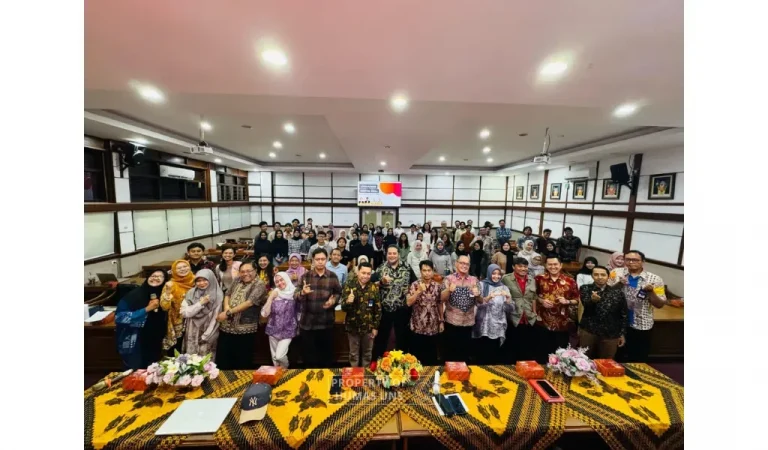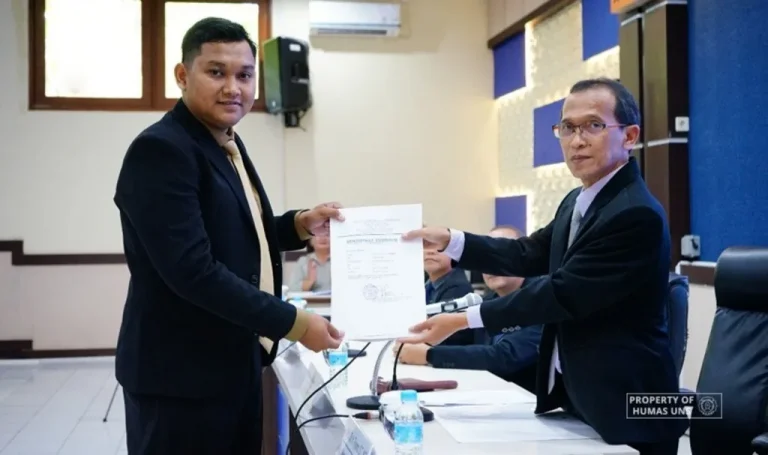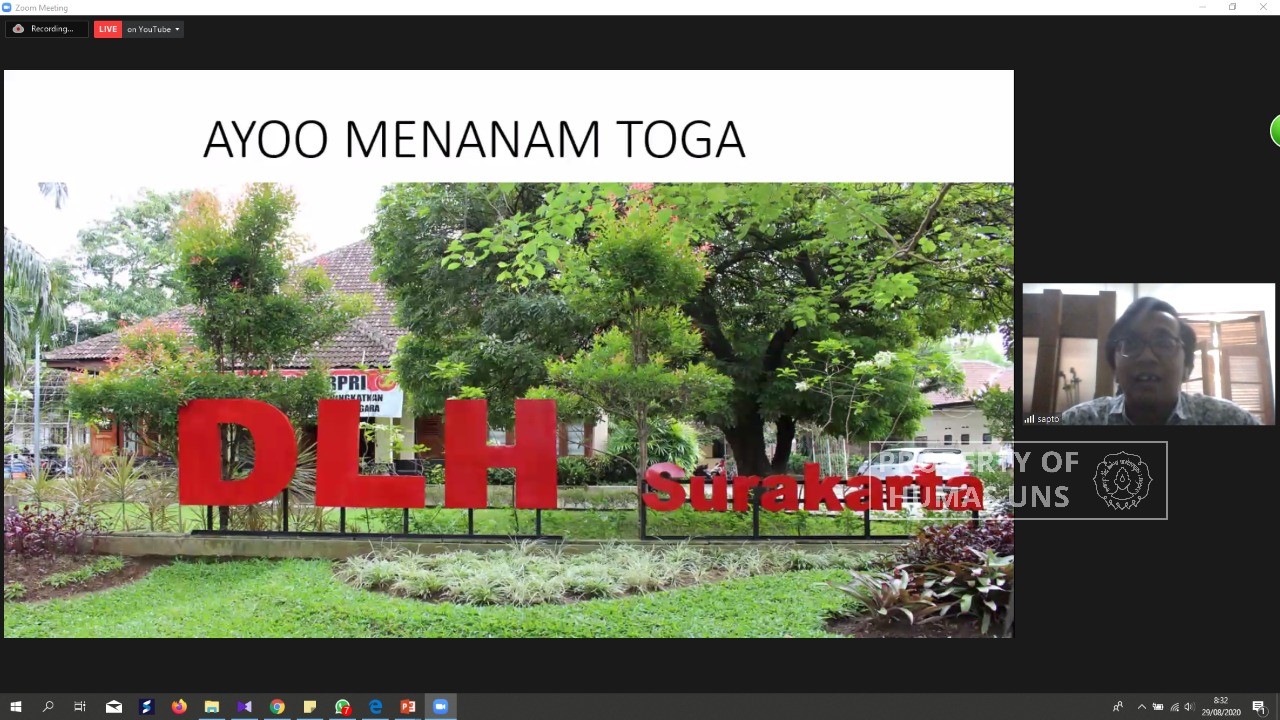
UNS — The Student Creativity Program in Community Engagement (PKM-M) Team, Ayoga, Universitas Sebelas Maret (UNS) Surakarta, hosted a webinar on the medicinal plants. The event entitled ‘The Importance of Family Medicinal Plant to Achieve Medication Autonomy’ take place on Saturday (29.8/2020), through Zoom Cloud Meeting Application and Youtube live Streaming. PKM-M Ayoga UNS invites Sapto Purnama, S.T., from Surakarta City Environmental Office, and Dr. Sugihardjo, a Lecturer from Agricultural Extension & Communication (PKP), Faculty of Agriculture (FP) UNS.
For the first material, Sapto Purnama delivers a material regarding Family Medicinal Plants (Toga). “The Family Medicinal Plants (Toga) currently is less familiar for the young generation, even more, it is difficult to get physical training. The history of the Toga plant begins in the year 500 BC (BC) where the mecca of civilization is in Egypt, where the community use plants as medicine. Afterward, the Greeks began to use medicinal plants around 400 BC,” he explains.
The utilization of Toga in Indonesia has taken place since a long time ago, there are even regulations that discuss the use of Toga. This is stipulated in Regulation of the Minister of Health Number 9 of 2016 concerning the Use of Family Medicinal Plants. “Our great-grandparents lived relatively longer because they consumed natural ingredients, both food, and medicine. Indonesia is a tropical country with rich biodiversity such as Toga, that can be utilized and tends to be cheaper than factory-made medicine because it can be self-produced. If you do not have a large yard, planting medicinal plants can be done using vertical planting media with used bottles or polybags,” he explains further.
Sapto also adds that Toga can be used as a source for additional nutrition and health, reforestation facilities, as well as efforts to prevent disease naturally. “Chemical drugs can make the kidneys work harder. Herbal medicine can be used as an option or alternative, which can be combined with other herbal plants,” he adds.
Meanwhile, Dr. Sugihardjo delivers material on the behavior that reflects ecological principles. Dr. Sugihardjo states that currently air, water, and soil pollution are increasing. “Natural disasters are becoming more frequent, flora and fauna are extinct and new diseases emerge. To overcome this problem, the government can provide an understanding of the community to understand the environment more. One of the efforts to implement this is by holding an Adiwiyata school that uses the Toga plant,” explains Dr. Sugihardjo.
He stressed that the community should have the initiative to plant useful plants that can increase economic value. The ecology is a reciprocal system between the organism and its environment. Toga can form a cool and comfortable micro-climate in the home environment,” he added.
Community involvement is needed, especially from the elementary, junior high, and high school students to become agents who support the Toga planting as an effort to provide medicine independence, both in the school and home environment. However, in achieving this, support from parents, teachers, and the community is needed to help socialize what things are the supporting factors for the plan. Humas UNS
Reporter: Bayu Aji Prasetya
Editor: Dwi Hastuti