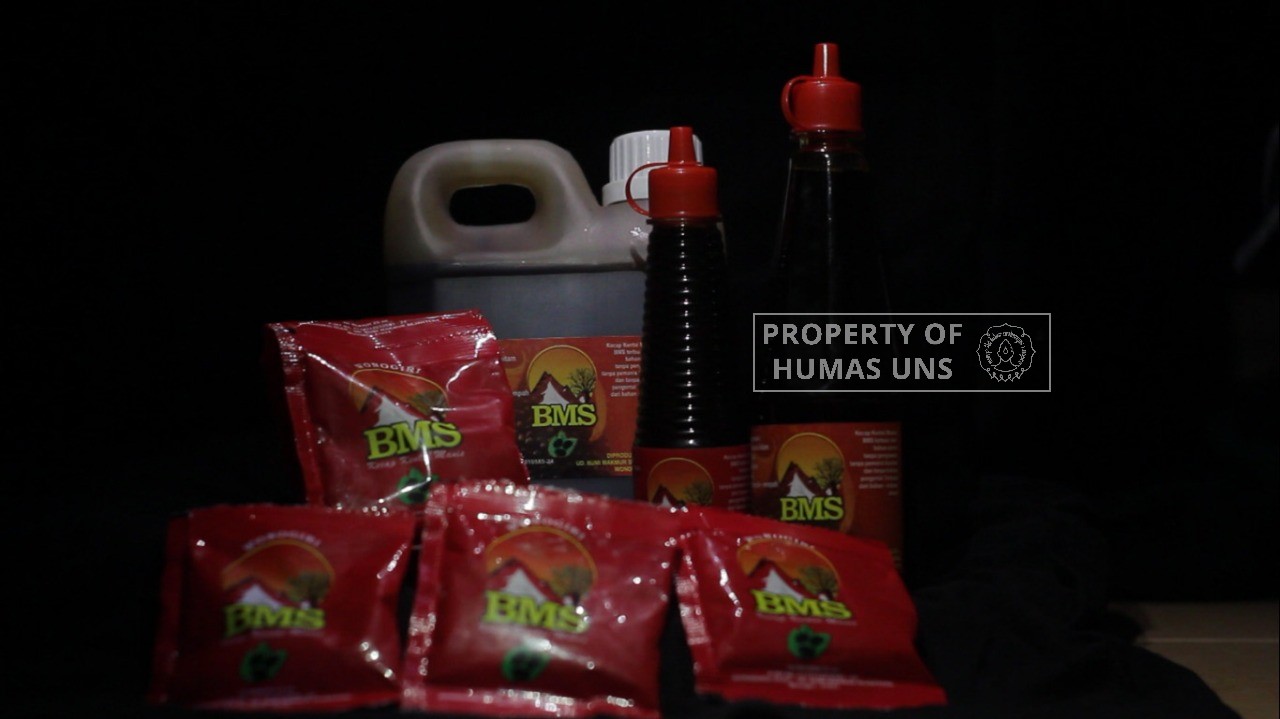
UNS — The team of community services that consists of cross-faculty UNS faculty members, Gusti Fauza, Ph.D from the Faculty of Agriculture, Catur Sugiarto, Ph.D from the Faculty of Economics and Business, and Heru Sukanto, ST, MT from the Faculty of Engineering, held a program to improve product quality and capacity of Wonogiri’s signature Sweet Soy Sauce (kecap), the BMS brand. This event ran for six months and targeted the Small and Medium Enterprises (SMEs) in Bulusari Village, Wonogiri. The program is predicted to complete in mid-December 2020.
The Community Service Team leader, Gusti Fauza, Ph.D stated that this program’s goal is to improve the capacity and process of kecap manis production to be more efficient and produce better product quality. This activity focuses on the introduction and application of kecap manis production technology in Bulusari Village, Wonogiri, Central Java. More specifically on the production capacity and the consistency of kecap manis quality.
“The demand for kecap is quite high, but SME has limited production in meeting the demands. SMEs also find obstacles in accessing and implementing effective, efficient, and safe technology,” Gusti Fauza explained Saturday (28/11/2020).
In his opinion, the academic community’s role is needed to produce and apply appropriate technology for SMEs. The team has handed production equipment to the SMEs, a trial has been implemented, and there is a change in production speed, which makes it possible to achieve efficiency up to the packaging stage. The main obstacle faced by Kecap Manis SMEs in Wonogiri located in the manual mixing system, long production period, which means the production capacity becomes limited. The taste and consistency of the kecap can still be optimized.
“We created an automatic multifunction machine that assists in the mixing process and other production processes, and of course made from safe material that meets the product safety standard,” Gusti Fauza added.
Some of the equipment used by the SMEs also require improvement, for example, the use of stainless-steel tools to maintain the quality and the safety of production results. On the marketing side, Catur Sugiarto stated that this program focuses not only on the production process, but also on assisting SMEs in improving their marketing performance. “The increase in production output must be followed by optimizing marketing activities; therefore, the production capacity can be absorbed well by the market,” he stated.
Marketing activities are focused on improving brand image and sales by assisting SME partners to build a website, optimize the use of social media, and sales through the marketplace. Humas UNS
Reporter: Dwi Hastuti