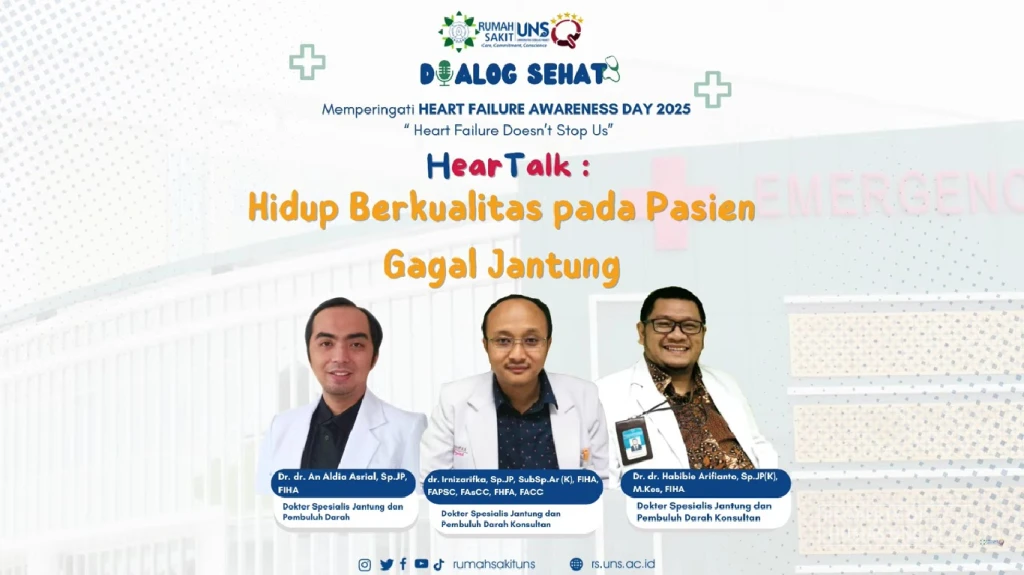
UNS – Cardiologists from Universitas Sebelas Maret (UNS) Hospital, who are also lecturers at the UNS Faculty of Medicine, hosted a public education session. They emphasized the importance of improving the quality of life for patients with heart failure. The session carried the theme “Heart Failure Doesn’t Stop Us”. Additionally, UNS Hospital organized it to commemorate the 2025 Heart Failure Awareness Day.
Dr. dr. An Aldia Asrial, Sp.JP., FIHA led the event along with two other specialists. They were Dr. dr. Habibie Arifianto, Sp.JP.(K), M.Kes, FIHA and dr. Irnizarifka, Sp.JP., SupSp. Ar. (K), FIHA, FAPSC, FAsCC, FHFA. The UNS Hospital YouTube channel broadcast the session on Tuesday (6/5/2025).
Understanding Heart Failure
Heart failure occurs when the heart cannot pump blood effectively to meet the body’s needs. This reduced function causes fluid buildup in the lungs, abdomen, and legs. Common causes include hypertension, coronary artery disease, cardiomyopathy, valvular disorders, and pregnancy-related heart disease.
“Fluid buildup in the lungs can lead to shortness of breath. Accumulation in the abdomen causes bloating, while buildup in the legs leads to swelling,” dr. Habibie explained. He added that people should seek immediate medical help if they experience certain symptoms. These include shortness of breath, fatigue, swelling, loss of appetite, sudden weight gain, or irregular heartbeat.
New Hope for Heart Failure Patients
In the past, many people considered a heart failure diagnosis a dead end. However, medical advancements now offer patients the chance to live better, longer lives. dr. Habibie explained that modern medications have proven effective in the last five to ten years. These medications reduce death rates, decrease hospitalizations, and improve the quality of life.

Treatment Guidelines Based on the Four Pillars
dr. An Aldia elaborated on the “Four Pillars” of heart failure therapy. These include:
• ARNIs (Angiotensin Receptor–Neprilysin Inhibitors) or ACE inhibitors or ARBs
• Beta-blockers like bisoprolol
• MRAs (mineralocorticoid receptor antagonists)
• Sodium-glucose co-transporter 2 inhibitors (SGLT2 inhibitors)
Doctors may also add diuretics to relieve fluid retention.
Equally important is adherence to medication schedules and a healthy lifestyle. “Doctors apply chronotherapy, aligning medication intake with the body’s natural rhythm,” dr. Habibie added. Doctors should prescribe beta-blockers to be taken in the morning. They should recommend taking diuretics on an empty stomach.
Regular physical activity also plays a role. Doctors encourage patients to exercise moderately for 150–200 minutes per week, spread across several sessions. According to dr. An Aldia, they regard physical activity as the fifth pillar in enhancing life quality.
The Role of Family Support
Support from family is critical—physically, emotionally, and spiritually. dr. An Aldia emphasized that family members act as motivators, helping patients stick to treatment plans and maintain healthy habits.

Cardiology Services at UNS Hospital
The American Heart Association has certified the UNS Hospital Heart Failure Clinic. It provides patient-centered treatment based on updated guidelines. Expert cardiologists staff the clinic and use advanced therapy models. “At UNS Hospital, we record all symptoms, medications, and progress,” dr. Irnizarifka said. “Our clinic treats approximately 1,400 patients annually. Patients with heart function below 40% can experience significant improvements within nine months. By consistently following three or four main treatment pillars, they may even achieve normalization.”
A Call for Greater Awareness
The UNS medical team urges the public to seek early evaluation if they observe heart failure symptoms. Prompt treatment allows patients to continue contributing to society actively.
dr. Irnizarifka concluded the session by emphasizing that heart failure does not limit the potential of patients, families, or physicians. With the right approach, a good quality of life is achievable. She added that this initiative supports the third Sustainable Development Goal (SDG): Good Health and Well-Being. HUMAS UNS