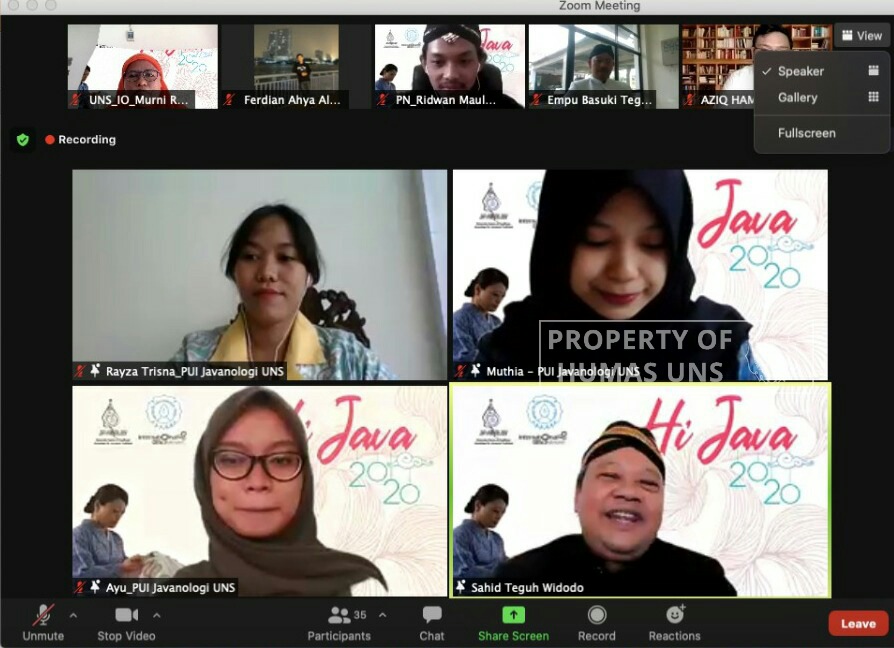
UNS — The International Office of the Universitas Sebelas Maret (UNS) Surakarta in collaboration with the University Centre of Excellence Javanology for Javanese Traditions (PUI PT Javanologi Kajian Tradisi Jawa) UNS organized the virtual `HI Java! Cultural Course 2020`. This time around, the Hi Java! Cultural Course is held virtually from Monday to Wednesday (23-25/11/2020) through Zoom Cloud Meeting. In total 256 participants from 14 countries are enrolled in this program.
The Head of UNS International Office, Irwan Trinugroho, Ph.D., states that, Hi Java! Cultural Course is a fortnight course for those with limited or no prior knowledge of the culture and Bahasa Indonesia, as well as the Javanese language. “This course aims to introduce the language, culture, and the life of Indonesian, especially Javanese people, to international students, in order to help them in achieving a better understanding of Indonesian nation,” Dr. Irwan explains on Wednesday (25/11/2020).
Meanwhile, the Vice-Rector for Partnership and Planning Affairs, Prof. Sajidan, in his opening remarks, states that the ongoing pandemic is not a hindrance to introducing Indonesian culture to the world.
“This pandemic cannot stop us to share the Javanese culture with the world. In fact, more people can join the program because the online platform has eliminated physical boundaries,” Prof. Sajidan remarked.
On the first day, the course discusses Kris as one of the elements in Javanese culture. According to the Head of the Centre of Excellence Javanology for Javanese Traditions, Prof. Sahid Teguh Widodo, Kris (keris) has been recognized as a Javanese cultural heritage. “The existence of Keris is acknowledged as Javanese humanity cultural heritage. Not only as a weapon, but keris also become a social status symbol and power in the community,” explains Prof. Sahid.
Meanwhile, a Keris expert, Empu (kris blacksmith) Wafi states that kris is a unique cultural heritage; hundreds of pamor (motif) and Warangka (scabbard) are the reasons why each kris is unique. Further, one of the Empu from Padepokan Brojobuwono, Empu Basuki, narrates the philosophical meaning behind a kris.
“For a Javanese man, kris is a symbol for a perfect life. A perfect life is when you have a house (as a symbol of stability), wife (a symbol of good offspring), turangga (horse) or vehicle (a symbol of spaciousness of living), kukila (bird/pet) as a symbol of appreciation toward art, and kris (as a symbol of a sense of responsibility and wisdom),” he explains.
Aside from kris, Hi Java! Cultural Course will discuss Batik and Javanese traditional art including Javanese song and traditional dance. Humas UNS
Reporter: Dwi Hastuti