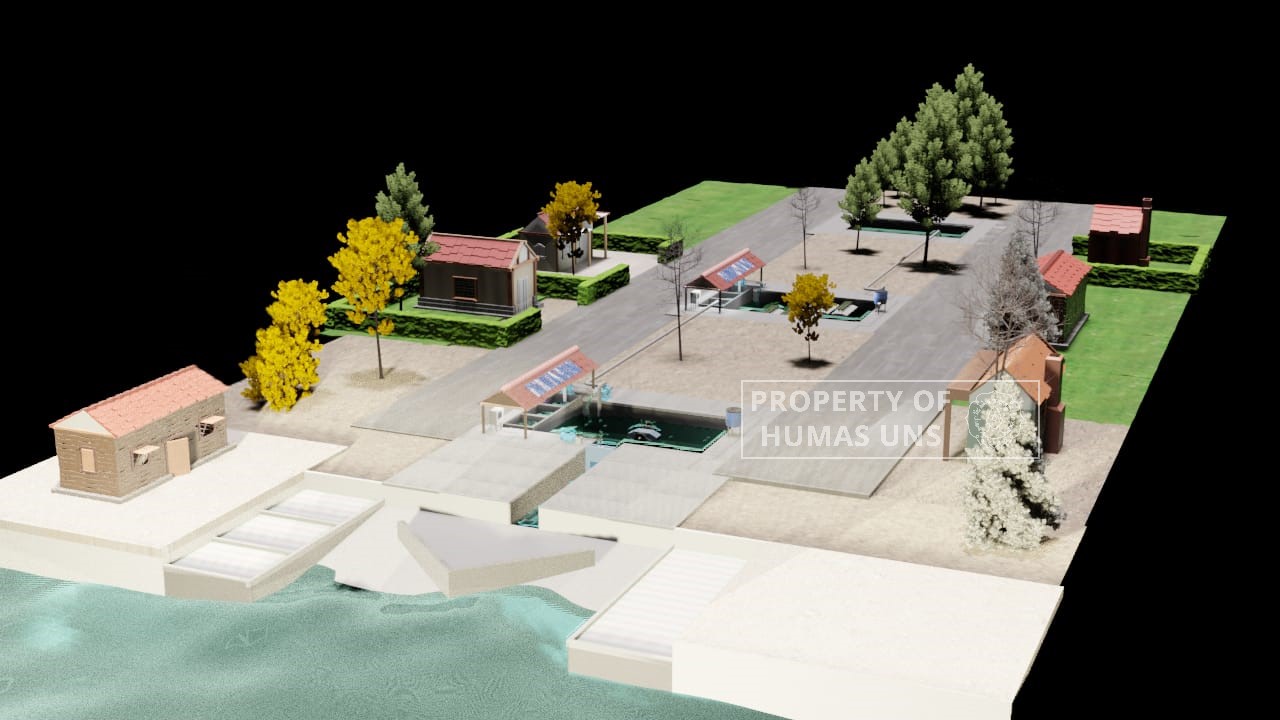
UNS — The coastal farming system is developed from year to year. Aquaponics is a system that combines fish and plant cultivation, which does not require a lot of lands. The students of Universitas Sebelas Maret (UNS) Surakarta made another innovation by creating a coastal farming system integrated with the internet of things technology. This system is designed to meet the high demand for agricultural commodities such as vegetables, shrimp, and fish.
The three UNS students who created this innovation are Nanda Hafidz Rivanda from the Faculty of Engineering (FT) UNS, Muhammad Iqbal Zidny from the Faculty of Engineering (FT) UNS, and Devie Febriansari from Faculty of Teacher Training and Education (FKIP) UNS. Under the supervision of Agus Ramelan, S.Pd., M.T from Electrical Engineering Program FT UNS, their innovation won funding from Student Creativity Program (Program Kreativitas Mahasiswa – PKM) 2020. Their proposal titled “Agriculture Cultivation through the Utilization of Seawater based on Integrated Farming System using Saltagrofish System” won an IDR 4.5 million from the Ministry of Education and Culture (Kemendikbud) RI.
“This idea started from the development of New Yogyakarta International Airport in Kulon Progo District in which there is empty land in its southern area which is not optimally utilized as coastal agricultural land,” Devie Febriansari, one of the team members, stated, Monday (23/11/2020).
She stated that farming systems using the aquaponic method is widely implemented, but the existing system is not integrated. Therefore, the result is limited to monoculture products. This system allows collaboration among the current approach to produce polyculture commodities. Besides, this system is also integrated with the Internet of Things (IoT) and Artificial Intelligence (AI). The design of their new system consists of four parts, salt pond (salt production), brackish pond (shrimp production), freshwater pond (fish and vegetable production), and retention basin (embung) for agricultural irrigation. “The advantages of this system are automatic, connected to IoT, friendly interface, energy friendly, and connected to AI, enabling this system to determine when filter should be cleaned and providing additional nutrition for shrimps, fishes, and plants,” Devie added.
Further, Devie stated that currently, she and her team are preparing to participate in the 33rd National Student Science Week (Pimnas) which will be hosted by Universitas Gadjah Mada (UGM). They have close communication with their supervisor to prepare a poster and presentation for the national event. Devie stated that her team hopes that they can win a medal from the national event and that their innovation will benefit farmers, especially in the coastal area. Humas UNS
Reporter: Dwi Hastuti