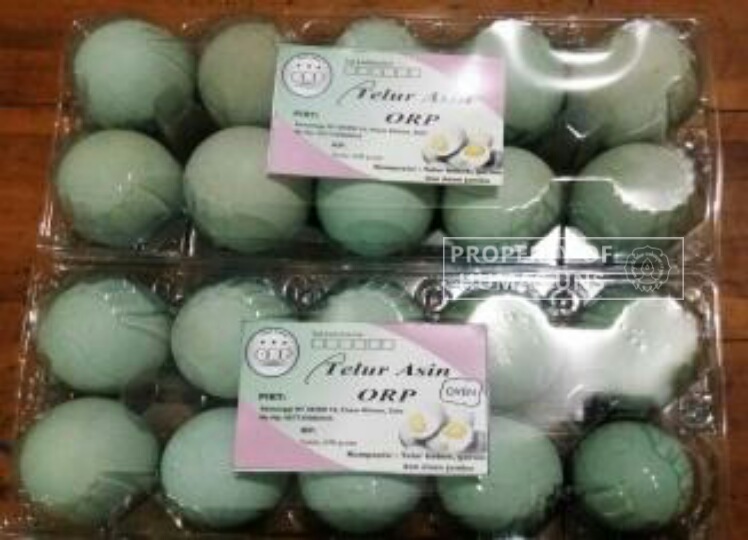
UNS — An innovative invention was made by three lecturers from the Food Technology Study Program, Faculty of Agriculture (FP) Universitas Sebelas Maret (UNS) Surakarta. The team consisting of Dr. Setyaningrum Ariviani, S.T.P., M.Sc, Dwi Ishartani, S.TP, M.Si., and Gusti Fauza, ST, MT, Dr.Phil., succeeded in finding an innovative low-sodium salted duck egg that is suitable for people with hypertension. This research on low sodium salted egg has graduated several students among others are Nur Hikmah Fitriyasih, Dyah Kartika Dewi, Liasandra Shafira, and Nidia Lestari.
The innovation made was in terms of the salting process that replace sodium salt (NaCl) with potassium chloride (KCl), teak leaf extract addition, and observation on the temperature and cooking time. Moreover, this team also offers the use of potential intensive ducks.
Regarding the replacement of NaCl with KCl, Dr. Setyaningrum states that an excess of Natrium (Na) intakes or sodium salt consumption can trigger hypertension and positively correlated with stroke risk. This can happen due to an imbalance between sodium and potassium. Meanwhile, KCl consumption is proved to reduce the cytosolic blood pressure in hypertensive rats. “Whereas, the salting process in salted egg production usually use sodium salt (NaCl), which leads to accumulation of NaCl in the in the yolk or other parts of the egg,” explains Dr. Setyaningrum, who also a member of Food, Nutrition, and Public Health Research and Development Center (P4GKM) UNS, Friday (29/1/2021).
Dr. Setyaningrum adds that the substitution of KCl reduces the sensory quality (color, aroma, taste, texture, or overall quality) of the salted egg. To resolve this, Dr. Setyaningrum and the team adds teak leaves extract in a salting mixture as a substitute for water. The research also uses semi-intensive duck eggs that common in salted egg production. The semi-intensive ducks are the duck livestock that grows under the Shepperd system. Hence its foods have come from pellets and natural food. As a comparison, the team applies the innovation on an intensive duck that parts of the cage system and only consume artificial feeds.
To extend the shelf life and addition of coarseness of the low sodium salted egg produced, the salted egg was cooked in the oven at 100 degrees Celcius for 30 minutes. This alternative provides the best sensory quality low sodium salted egg. It cannot be denied that the main factor of consumer acceptance and market demand for salted eggs is the texture of the egg yolk. The sandy textured and the oily yolk is more preferred by consumers. Another excellence is the shelf life of salted eggs that reaches 12 days.
“This research result gives an alternative for the development of intensive duck egg for low sodium salted egg production. Moreover, this innovation resulted in safer salted egg with better quality,” explains Dr. Setyaningrum. Humas UNS
Reporter: Kaffa Hidayati
Editor: Dwi Hastuti