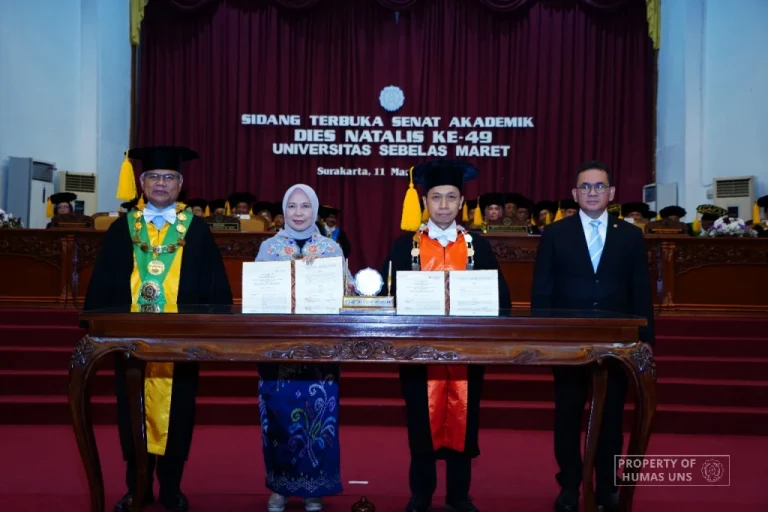
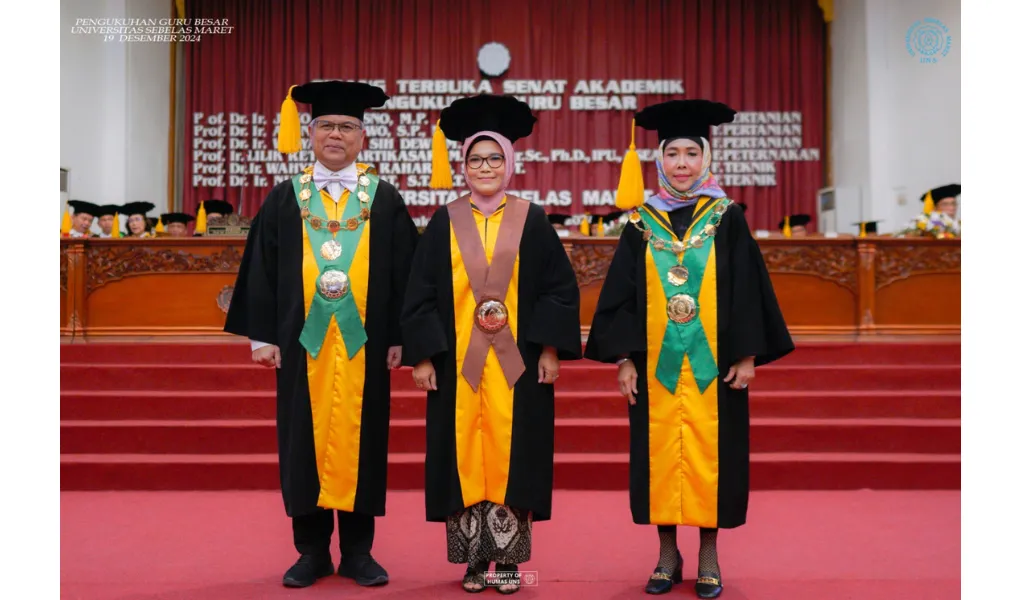
UNS – Research on the potential of omega-3-enriched meat and eggs has propelled Prof. Ir. Lilik Retna Kartikasari, M.P., M.Agr.Sc., Ph.D., IPU., ASEAN Eng., to become the latest Professor at Universitas Sebelas Maret (UNS) Surakarta. Her inauguration took place during the UNS Academic Senate Open Session at the G.P.H. Haryo Mataram Auditorium on Thursday (19/12/2024). Prof. Lilik is the seventh professor in the Faculty of Animal Husbandry (Fapet) and the 324th at UNS.
Prof. Lilik was inaugurated as a professor in the field of Animal Product Technology. Her inaugural address, titled “The Potential of Omega-3 Meat and Eggs as Sustainable Functional Foods”, provided insights and recommendations for producing functional foods with optimal nutritional value.
In her speech, Prof. Lilik emphasized the critical role of functional foods in supporting Indonesia’s government policies, particularly in achieving the Sustainable Development Goals (SDGs). She highlighted livestock products, such as meat and eggs, as essential functional food sources.
Advances in animal feed technology now enable the production of meat and eggs with enhanced nutritional profiles. These products can contain higher levels of omega-3 polyunsaturated fatty acids, which not only improve their nutritional value but also have the potential to reduce cholesterol levels.
The Dean of the Faculty of Animal Husbandry elaborated on methods to produce omega-3-enriched eggs. She explained that such enrichment could be achieved by formulating chicken feed with ingredients rich in omega-3 fatty acids. Marine-based feed components, such as fish meal and fish oil, can boost levels of long-chain omega-3 polyunsaturated fatty acids (PUFA), including EPA and DHA, in chicken eggs and meat.
However, Prof. Lilik noted that using marine-based feed ingredients often results in a “fishy” aroma and flavor. To maintain product quality and sensory appeal, she recommended limiting fish oil supplementation in poultry feed to a maximum of 1,5%.
As an alternative, she proposed plant-based omega-3 feed supplements, which preserve the sensory properties of the products. Plant sources such as flaxseed oil, chia seeds, and canola are rich in omega-3 alpha-linolenic acid (ALA) and can serve as sustainable feed additives. However, optimizing the ratio of linoleic acid (LA) to alpha-linolenic acid (ALA) in feed formulations is crucial to maximizing omega-3 accumulation in eggs and meat.
“In broiler chickens of the Cobb strain fed with a diet containing 6% ALA, the total omega-3 PUFA in breast meat reached 338 mg per 100 grams. This finding demonstrates that chickens fed ALA-enriched diets can produce eggs and meat that meet the minimum labeling requirements for omega-3 PUFA sources, 300 mg per egg or 300 mg per 100 grams of meat. These products are also sensory-acceptable to consumers,” Prof. Lilik explained.
The development of functional foods rich in omega-3 PUFA also offers the potential to reduce cholesterol levels in eggs and meat, making it a significant strategy for improving public health. Prof. Lilik’s innovations aim to provide sustainable alternative omega-3 sources and address the nutritional needs of the community.
The Chair of the UNS Board of Professors, Prof. Drs. Suranto Tjiptowibisono, M.Sc., Ph.D., praised the focus on sustainable functional food development. “We are learning how to consume healthier foods with the role of omega-3 in lowering cholesterol levels in both eggs and meat. This is an excellent effort to achieve sustainable functional food production,” Prof. Suranto said.
With Prof. Lilik’s expertise, UNS contributes to advancing education quality while directly supporting several SDG targets, particularly Goal 4 on quality education. Humas UNS